
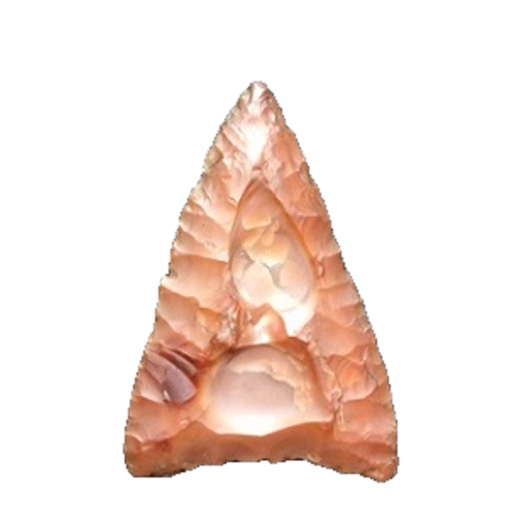
Arrowhead type
Pomranky Point
PomrankyEastern Archaic Triangle Cluster3,300 - 2,500 B.P.Late Archaic to Early Woodland3 reference photos
Key facts
- Age
- 3,300 - 2,500 B.P.
- Cultural period
- Late Archaic to Early Woodland
- Culture
- Late Red Ocher Complex
- Size
- Medium
- Shape
- Triangle
- Glacial period
- Neoglacial
Description
The specimen exhibits a triangular morphology of medium size, characterized by an elliptical cross-sectional profile. The blade's curvature is excurvate, with certain examples displaying parallel lateral margins. The basal margins are smoothly rounded, while the base itself can vary in shape, ranging from concave to convex, or even asymmetric. The flaking pattern observed on this point is random, lacking a discernible or consistent sequence.
Size
Medium
Distribution
This type exhibits the greatest abundance in Michigan, prevalent throughout the entire Great Lakes area
Additional information
In his seminal work published in 1963, Binford identified three distinct variants of Native American arrowheads, each characterized by unique basal morphology. The Midland Variety is notable for its straight to concaved base, a trait that distinguishes it from other types. In contrast, the Swan Creek Variety exhibits rounded basal edges, paired with a convex base, showcasing a more curved profile. A third variant, the Saginaw Variety, is marked by its smaller size and an irregularly shaped base, setting it apart from its counterparts.
These variations highlight the diversity and complexity of arrowhead design among Native American cultures. The differences in basal shape and size may reflect regional or cultural preferences, as well as adaptations to specific hunting or warfare strategies. Further study of these variants can provide valuable insights into the technological, social, and environmental contexts in which they were created and used.
The identification of these three variants by Binford has significant implications for the field of archaeology, as it allows researchers to better understand the cultural and historical contexts of Native American arrowheads. By examining the characteristics of each variant, researchers can reconstruct the lives and traditions of the people who crafted and used these artifacts, shedding light on the rich and diverse heritage of Native American cultures.
Identified by
- Named by
- Lewis R Binford
- Year
- 1963
- Type site
- Pomranky Site, Midland County, Michigan
Similar types
Types that are easy to confuse with the Pomranky point.
- Decatur Blade
- Levanna
- Susquehannock Triangle