Named stone
Zaleski, Plum Run and Delaware cherts
Also called Zaleski flint, Zaleski Black, Plum Run chert, Delaware flint, Delaware chert
A kind of chert (and flint)
Zaleski, Plum Run and Delaware chertsChert (and flint)Midwest/Ohio Valley2 photos
Description
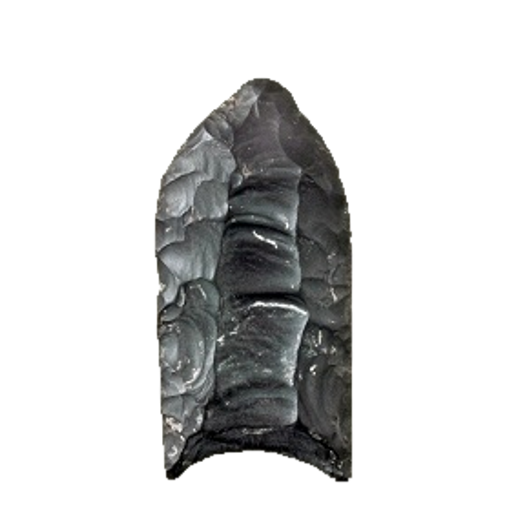
Three smaller Ohio flints often come up beside the famous ones. Zaleski flint is a black to brownish-black, hard, lustrous flint from the Pennsylvanian Zaleski horizon in southern Vinton and northern Jackson counties, where the deposit covers perhaps 130 square miles. It is denser than Upper Mercer flint, with fewer cavities, a slightly browner tone and a more resinous luster. Plum Run chert comes from the same Vanport limestone as Flint Ridge flint but is thinner, poorer and mostly blue-gray, weathering brown. Delaware chert is a Devonian chert from the Delaware limestone in a belt from the Columbus area to Lake Erie; the best pieces are dark gray with a sharp conchoidal fracture and wear a white coating.
How to identify it
- Colour
- Zaleski: black or brownish black; limy varieties light gray to grayish brown (Stout and Schoenlaub). Plum Run: mostly blue-gray weathering to brown (Luedtke, cited by Boulanger). Delaware: dark and dark gray in the best pieces.
- Texture
- Zaleski: hard flint with sharp edges and a deep conchoidal fracture; Delaware: the best flint is amorphous and breaks with a sharp conchoidal fracture.
- Luster
- Zaleski: lustrous, more resinous than Upper Mercer.
- Inclusions
- Zaleski hard flint is sparingly fossiliferous; calcareous varieties are very fossiliferous.
- Cortex
- Nodular and stringer Delaware flint has a white coating on the outside.
Geology
Zaleski flint comes from the Zaleski member (Pennsylvanian), recognised in Ohio only in southern Vinton and northern Jackson counties, near McArthur, Zaleski and Hamden, in a basin of perhaps 130 square miles; the flint forms the roof of the Ogan coal and carbon is its main pigment. Plum Run chert is from the Vanport Limestone member of the Allegheny Formation (the same unit as Flint Ridge), and is treated by archaeologists as separate because of colour and quality; Luedtke found it enriched in lutetium, zinc and chromium relative to Flint Ridge. Delaware chert comes from the Devonian Delaware formation, which crosses Ohio in a narrow belt from western Pickaway County past Columbus, Delaware and Marion to Sandusky, with an outlier in northwestern Ohio.
Where it comes from
Midwest/Ohio Valley
States
Quarries and outcrops
- Vinton and Jackson counties, Ohio (Zaleski flint, near McArthur, Zaleski and Hamden)
- Plum Run, Ohio (Vanport limestone; exact county not given in the opened text)
- Franklin, Delaware and Marion counties, Ohio (Delaware flint, including bluffs along the Scioto River from Columbus northward)
Used by
- Zaleski was one of Ohio's three chief prehistoric flint sources, with Vanport (Flint Ridge) and Upper Mercer (Stout and Schoenlaub; Getz)
- Delaware flint was used by Native people mostly for rougher implements (Stout and Schoenlaub)
Look-alikes
Stones that are easy to confuse with Zaleski, Plum Run and Delaware cherts.
- Upper Mercer flint (similar to Zaleski)
- Flint Ridge flint (Plum Run comes from the same bed)
- Other Devonian cherts of Ohio such as the Columbus formation
Sources
- Stout, W. E., and R. A. Schoenlaub. 1945. The Occurrence of Flint in Ohio. Ohio Geological Survey, Fourth Series, Bulletin 46. Ohio Department of Natural Resources.dam.assets.ohio.gov (opens in a new tab)
- Boulanger, Matthew T. 2022. Neutron Activation Analysis and X-ray Fluorescence of Chert Artifacts from Mielke #1 (33SH26), Shelby County, Ohio. Supplementary Text S1, Midcontinental Journal of Archaeology.midwestarchaeology.org (opens in a new tab)
- Getz, Garry L. 2016 (rev.). Flint: Ohio's Official Gemstone. Educational Leaflet No. 6. Ohio Department of Natural Resources, Division of Geological Survey.dam.assets.ohio.gov (opens in a new tab)