
Named stone
Uwharrie and Carolina Slate Belt metavolcanics
Also called Uwharrie rhyolite, Carolina slate, Carolina felsite, Morrow Mountain rhyolite, Slate Belt rhyolite and dacite
A kind of rhyolite, felsite and metavolcanic rock
Uwharrie and Carolina Slate Belt metavolcanicsRhyolite, felsite and metavolcanic rockSoutheastDescription
The Carolina Slate Belt is a long belt of ancient volcanic and sedimentary rock running from central Virginia to central Georgia, widest in central North Carolina, and it supplied most of the Piedmont's toolstone. Despite the traditional name rhyolite, geologists say most of the felsic stone is dacite or rhyodacite. Typical Uwharrie stone is dark gray, fine grained and breaks cleanly, with flow banding, and weathers to a chalky gray-white rind; some contains tiny spherulites. Quality varies sharply, even within one quarry such as Three Hat Mountain, where 24 rock groups were recorded. Flow-banded Uwharrie stone was carried over 100 km toward the South Carolina coast, and Morrow Mountain points are a classic product.
How to identify it
- Colour
- Dark gray (Morrow Mountain rhyolite, Virginia DHR); light gray to grayish black with some green and very light gray tuffs at Three Hat Mountain (Abbott).
- Texture
- Fine grained with excellent conchoidal fracture; Slate Belt breccias are difficult to knap.
- Inclusions
- Flow banding, small spherulites about 1 mm across, plagioclase and quartz phenocrysts in different Uwharrie types; white calcite in Uwharrie tuffs and pyrite in Tillery tuffs near Asheboro.
- Cortex
- Aged pieces develop a chalky grayish-white patina (Virginia DHR).
Geology
The Slate Belt is a belt of late Proterozoic to Cambrian metavolcanic and metasedimentary rocks, about 640 km long, with a maximum width of 140 km in central North Carolina. The Uwharrie Formation is mainly felsic metavolcanic rock (tuff, lapilli-tuff, breccia, welded tuff). Daniel and Butler sorted Uwharrie rhyolite into four types: aphyric (including flow-banded), plagioclase porphyritic, quartz porphyritic, and plagioclase-quartz porphyritic. Most of the 'rhyolite' is actually dacite or rhyodacite because it has plagioclase phenocrysts. The stone formed in lava flows that cooled rapidly and then were lightly metamorphosed.
Where it comes from
Southeast
Quarries and outcrops
- Morrow Mountain, North Carolina (site 31ST18; the reference collection location for Morrow Mountain rhyolite)
- Uwharrie Mountains (quarries studied by Daniel and Butler for the Hardaway site, Montgomery County)
- Three Hat Mountain quarry, Davidson County, North Carolina (site 31DV51)
- Quarries near Asheboro, North Carolina (Uwharrie and Tillery formation rocks)
Used by
- Early Archaic through Late Woodland: Morrow Mountain rhyolite (Virginia DHR)
- Late Archaic to Mississippian: Ashe Ferry assemblage dominated by metavolcanic stone, mostly dark gray to black aphyric rhyolite (Research Report 36)
- Early Archaic: planned stone-gathering trips to Uwharrie quarries (Daniel's model, per Abbott)
Look-alikes
Stones that are easy to confuse with Uwharrie and Carolina Slate Belt metavolcanics.
- Chert-like fine-grained metarhyolite from Maryland (Catoctin) or Virginia (Mount Rogers)
- Argillite and other Slate Belt metasedimentary rocks, which appear in the same quarries
Sources
- Abbott, Lawrence E., Jr. 2004. An Assessment of Lithic Extraction Technology at a Metavolcanic Quarry in the Slate Belt of North Carolina. Office of State Archaeology, North Carolina.archaeology.ncdcr.gov (opens in a new tab)
- North Carolina Office of State Archaeology. Geology for Archaeologists: Slate Belt lithic materials (web site).archaeology.ncdcr.gov (opens in a new tab)
- Egloff (after Daniel and Butler 1996). 2008. Morrow Mountain Rhyolite-Uwharrie Mountains. Virginia Department of Historic Resources, Lithics (Projectile Points and Lithics guide).dhr.virginia.gov (opens in a new tab)
- Research Laboratories of Archaeology, University of North Carolina at Chapel Hill. Research Report 36, Chapter 6: Chipped-Stone, Ground-Stone, and Other Artifacts (Ashe Ferry site, Carolina Piedmont; PDF dated 2015).rla.unc.edu (opens in a new tab)
Points made from this stone
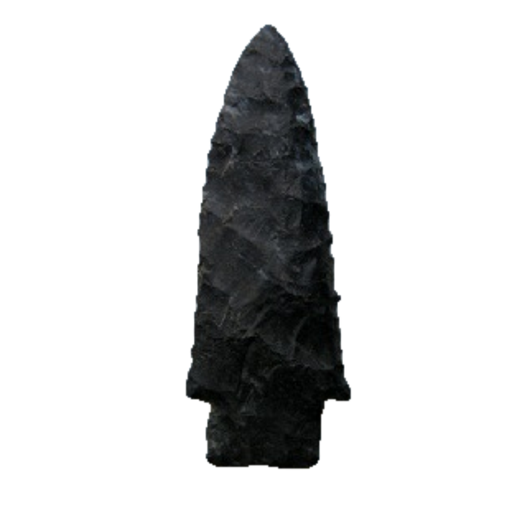 Kirk SerratedEarly Archaic8,900–8,000 B.P. (St. Albans, West Virginia; Maryland JPPM); about 8,150–7,650 cal B.P. (6200–5700 B.C.; Virginia DHR); 7,950–6,950 B.P. (6000–5000 B.C.; Coe, cited by Cambron and Hulse 1975)
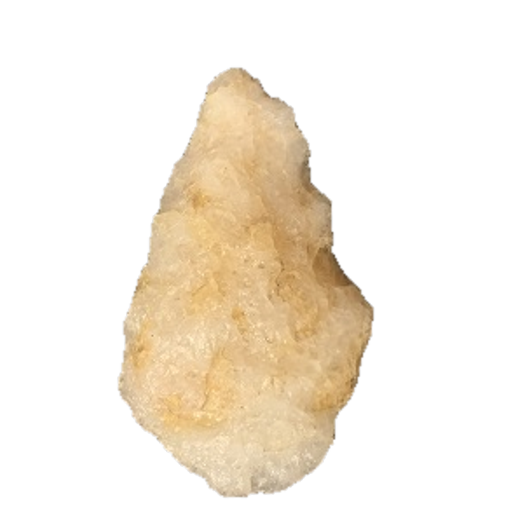 Morrow MountainMiddle Archaic7,100–6,200 B.P. (Maryland JPPM); on the Nottoway River, Virginia, about 7,100–6,700 B.P. for type I and 6,800–6,200 B.P. for type II; 5500–5000 B.C. at Doerschuk and in southeast Tennessee (UNC RLA)
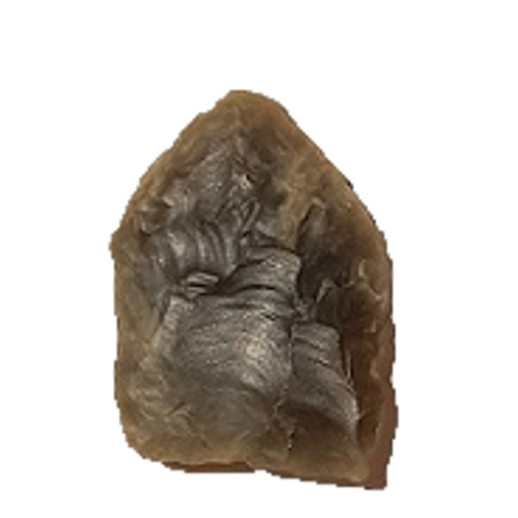 Pee DeeLate Prehistoric (South Appalachian Mississippian)Late prehistoric, tied to the Pee Dee culture, which North Carolina Historic Sites places at about A.D. 1000 - 1400 (roughly 950 - 550 B.P.)
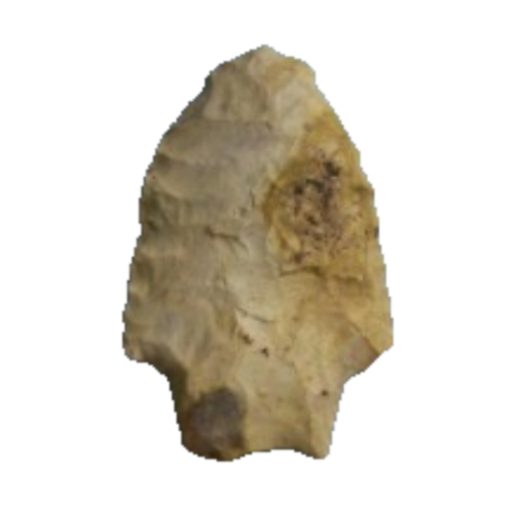 Savannah RiverLate Archaic to Early WoodlandAbout 4,865–3,260 B.P. (Warren Wilson site, North Carolina, to Pony Pasture site, Virginia), many dates 3,900–3,700 B.P. (Maryland JPPM); 3000–1800 B.C. at the Bacon Bend site, Tennessee (UNC RLA)