
Named stone
Swan River chert
Also called SRC
A kind of chert (and flint)
Swan River chertChert (and flint)PlainsDescription
Swan River chert is the everyday toolstone of the northeastern Plains and western Minnesota. Most of it was not quarried from one place: glaciers spread cobbles through the drift from eastern Saskatchewan and southwestern Manitoba across the eastern Dakotas and much of Minnesota, and probably into northern Iowa. Outcrops are reported in the Swan River valley of west-central Manitoba. Colour varies a lot, but the stone usually looks mottled, like curdled milk, with small cavities, a fracture surface that feels like orange peel, and a spongy or ropy rind. Raw cobbles are so tough that knappers often heated whole cobbles before working them; finished tools were durable. Points of it include Agate Basin points at Beacon Island, North Dakota, and a Mummy Cave point at Head-Smashed-In, Alberta.
How to identify it
- Colour
- Extremely variable (Bakken). Usually mottled with a curdled-milk look; white, light to medium grey, brown and yellow, with orange, red and purple produced by heating (Bubel). Held to a light, thin edges glow a cloudy yellow (Bakken).
- Texture
- Heterogeneous, medium to very fine grained (Bubel). Breaks have an orange-peel texture on which single flake scars are hard to make out (Bakken). Microscopic agate-like banding is one of the best clues (Bakken). Opaque to moderately translucent (Bubel).
- Luster
- Dull to vitreous; waxy after heating (Bubel).
- Inclusions
- Small irregular cavities (vugs), sometimes lined with quartz crystals, and feather- or needle-like microfossils (Bubel).
- Cortex
- Spongy or ropy rind, distinctive when present (Bakken).
- Heat treatment
- Usually heat-treated before knapping (Bubel). At some Minnesota sites whole cobbles, not partly worked blanks, were heated, probably because the raw stone is so hard to break (Bakken). Heating changes the texture in subtle but visible ways (Bakken) and brings out orange, red and purple colours and a waxy lustre (Bubel).
Geology
A chert known mainly as cobbles in glacial till, outwash and stream gravels across the northern Plains and Minnesota (Bakken; Bubel). Bubel lists bedrock outcrops in the Swan River valley of west-central Manitoba. A 2002 Plains Anthropologist paper by Grasby, Gryba and Bezys reports a bedrock source; it was not opened, so its details are not used here.
Where it comes from
Plains, Midwest/Ohio Valley
Quarries and outcrops
- Swan River valley, west-central Manitoba (outcrops, per Bubel)
- Glacial drift of eastern Saskatchewan, southwestern Manitoba, the eastern Dakotas and much of Minnesota (Bakken)
- Alluvial and glacial cobbles across southern Saskatchewan and Alberta (Bubel)
- Probably northern Iowa (Bakken) and possibly northern Montana (Bubel)
Used by
- Paleoindian, Agate Basin: about 10 percent of the Agate Basin points at Beacon Island, North Dakota (Ahler and McGonigal 2001)
- Early Middle Prehistoric, Mummy Cave: point base from the Processing Area at Head-Smashed-In Buffalo Jump, Alberta (Bubel et al. 2022)
- By far the most common local stone at sites in Rock and Pipestone counties, southwestern Minnesota (Bakken)
- Saskatchewan: people travelled to glacial gravels to gather it (Saskatchewan Archaeological Society guide)
Look-alikes
Stones that are easy to confuse with Swan River chert.
- Warsaw chalcedonic chert (Iowa): lacks the microscopic banding and distinctive rind (Bakken)
- Some Prairie du Chien chert (Minnesota): same test (Bakken)
- Red River chert (Cathead and Selkirk cherts of Manitoba), the second most common local stone of western Minnesota, usually light coloured (Bakken)
Sources
- Bakken, Kent E. (written about 1995; PDF issued later). Chipped Stone Raw Materials. Chapter 6 in Stone Tools of Minnesota. Minnesota Office of the State Archaeologist, St. Paul.mn.gov (opens in a new tab)
- Bubel, Shawn. n.d. Classification of Lithic Material Types in Artifact Collections from Archaeological Sites in Alberta. Teaching guide, University of Lethbridge.people.uleth.ca (opens in a new tab)
- Ahler, Stanley A., and Michael McGonigal. 2001. Agate Basin at Beacon Island, North Dakota. Current Research in the Pleistocene 18:1-3.liberalarts.tamu.edu (opens in a new tab)
- Bubel, Shawn, Robert J. Dawe, and Kevin McGeough. 2022. The 2021 excavations at Head-Smashed-In Buffalo Jump, UNESCO World Heritage Site. Archaeological Survey of Alberta Occasional Paper 42.open.alberta.ca (opens in a new tab)
- Steuber, Karin, and Denise Huynh (compilers). 2012 (revised 2018). A Guide to Saskatchewan Archaeology. Saskatchewan Archaeological Society, Saskatoon.thesas.ca (opens in a new tab)
- Grasby, S.E., E.M. Gryba, and R.K. Bezys. 2002. A Bedrock Source of Swan River Chert. Plains Anthropologist 47(182).researchgate.net (opens in a new tab)
Points made from this stone
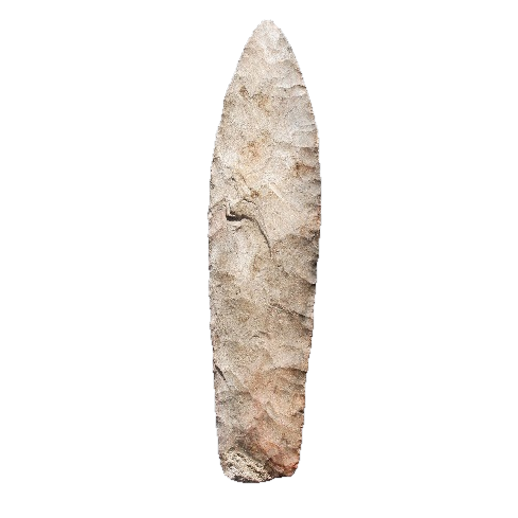 Agate BasinLate Paleoindian10,500–10,000 B.P.; charcoal from the Agate Basin level at Area II of the type site dated 10,430 ± 570 B.P. (MVAC)
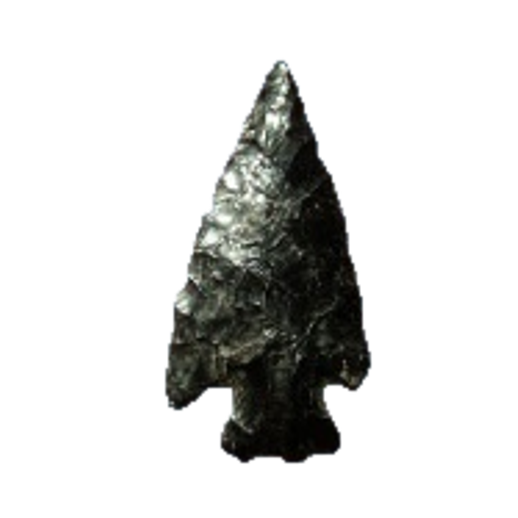 Mummy CaveEarly to Middle Archaic (Middle Holocene)7,630–6,780 B.P. at Mummy Cave, Layers 16–18 (Husted and Edgar 2002); about 5,800–3,800 years ago at Head-Smashed-In, Alberta (Brink 2020).