Named stone
Normanskill chert
Also called Mount Merino chert, Coxsackie chert (name used on the Maryland diagnostic-artifact guide)
A kind of chert (and flint)
Normanskill chertChert (and flint)NortheastDescription
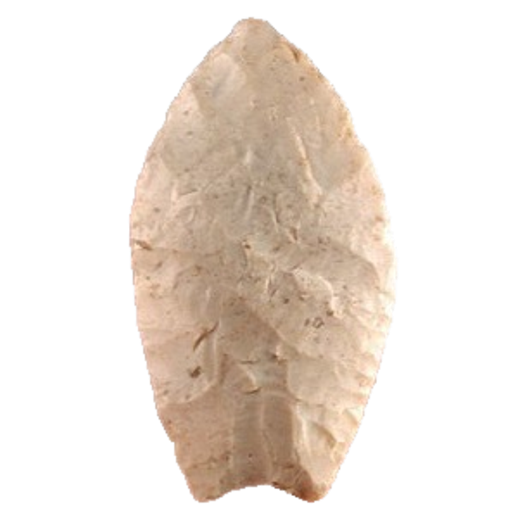
Normanskill chert is the green-to-black chert that Paleoindians quarried in the Hudson Valley of eastern New York. Archaeologists use the name for chert from the Mount Merino part of the Ordovician Normanskill rocks, which supplied the Flint Mine Hill and West Athens Hill quarry-workshops in Greene County. Colours run green, olive, bluish green and black, sometimes with red or gray, and the stone is smooth with a dull to waxy luster. It weathers white or brown. At West Athens Hill only 2.5 percent of the tools were any other stone. Fluted points of this chert also reach well beyond the Hudson Valley, and it sits beside Munsungun and Hardyston cherts in some Northeast Paleoindian assemblages.
How to identify it
- Colour
- Mostly green, green and black, black, bluish green and dark olive green; sometimes red, red with black, grayish green or dark gray (Funk, who lists Munsell values such as 5BG 4/1, 5GY 3/1 and 5Y 3/1).
- Texture
- Smooth.
- Luster
- Dull to waxy.
- Cortex
- Weathers mostly white or brown (a weathered rind).
Geology
Normanskill chert is a general archaeological label for chert in the Mount Merino unit of the Normanskill series; the Indian River unit also yields gray, green, black and occasionally red chert, and the Austin Glen member has none. Chert also occurs in the older Deepkill formation. In Greene County the Normanskill rocks lie east of the Helderberg escarpment, thrust there during the Taconic mountain-building, and project above glacial Lake Albany sediments. The age is given as Lower Ordovician in Funk's appendix but Middle Ordovician in Lang's thesis on Mount Merino chert, so this page says only Ordovician. Lang suggests the silica came from volcanic activity.
Where it comes from
Northeast
States
Quarries and outcrops
- Flint Mine Hill, Coxsackie, Greene County, New York (quarry-workshop)
- West Athens Hill, Greene County, New York (quarry-workshop)
- Scott Farm and other Greene County quarry sites
Used by
- Paleoindian (fluted-point period): the dominant stone at West Athens Hill (Funk)
- Hudson Valley fluted-point sites, often together with Munsungun and Hardyston cherts in Northeast assemblages (Kitchel 2024)
Look-alikes
Stones that are easy to confuse with Normanskill chert.
- Helderberg group chert, especially dark Kalkberg: Funk says it could easily be confused with dark gray to black Normanskill, and trace-element studies found very similar profiles
- Deepkill chert (apple-green, weathers brownish) from the older underlying formation
- Onondaga chert of the eastern variety (dull, uniform dark brown-blue to black)
Sources
- Funk, Robert E. 2004. An Ice Age Quarry-Workshop: The West Athens Hill Site Revisited. New York State Museum Bulletin 504. University of the State of New York, Albany.exhibitions.nysm.nysed.gov (opens in a new tab)
- Lang, Dorothy M. 1969. Mount Merino chert and shale (thesis). University at Albany, State University of New York.scholarsarchive.library.albany.edu (opens in a new tab)
- Kitchel, Nathaniel R. 2024. Facing the Forest: Climate Change and Human Adaptation Across the Pleistocene-Holocene Transition in Northern New England and Eastern Canada. PaleoAmerica (online 28 Oct 2024). doi:10.1080/20555563.2024.2414630.par.nsf.gov (opens in a new tab)
- Maryland Archaeological Conservation Laboratory. Chert. Diagnostic Artifacts in Maryland: Common Stone Types.apps.jefpat.maryland.gov (opens in a new tab)