Named stone
Lockatong and Brunswick argillite
Also called Delaware Valley argillite, Lockatong argillite, Brunswick (Passaic Formation) hornfels
A kind of argillite, hornfels, slate and siltstone
Lockatong and Brunswick argilliteArgillite, hornfels, slate and siltstoneMid-AtlanticDescription
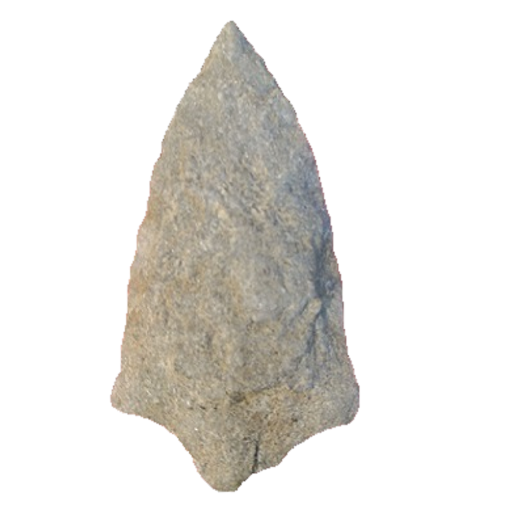
Delaware Valley argillite is the dark Triassic mudstone of the Newark Basin, quarried in huge amounts along the Delaware River above Trenton in Hunterdon and Mercer counties, New Jersey, and Bucks and Montgomery counties, Pennsylvania. Most comes from the Lockatong Formation, whose tough, massive gray mudstone layers form the argillite; near diabase sills the Lockatong and the overlying Brunswick (Passaic) mudstones were baked into harder hornfels. Fresh stone is black to gray and grainy. It is softer than chert and weathers quickly to lighter gray, green, purple or mottled surfaces, sometimes a soft, clay-like rind. Quarry pits are known at Gaddis Run, with workshops at Byram (NJ) and Lower Black's Eddy (PA); cobbles also came from river gravels. People used it from the Early Archaic into the Woodland, especially for stemmed points and broadspears such as Koens-Crispin, and traded it to the coast.
How to identify it
- Colour
- Black to gray when fresh; weathered surfaces turn lighter gray, green, purple or variegated (Digging I-95, AECOM for PennDOT). Hornfels in Brunswick mudstone near the Lambertville sill is pale lavender, or dark gray close to the contact (Van Houten 1980).
- Texture
- Grainy; softer than cryptocrystalline quartz such as chert.
- Cortex
- Weathers easily and quickly, leaving a softened, clay-like rind on artifact surfaces (DelDOT glossary); weathered stone can become soft and porous.
Geology
Late Triassic Newark Supergroup of the Newark Basin. In the Lockatong Formation, short sedimentary cycles end in tough, massive gray calcareous mudstone (the argillite). Where diabase sills such as the Byram and Lambertville sills intruded, Lockatong and Brunswick (now Passaic Formation) mudstones were thermally altered to hornfels. Argillite forms by low-grade metamorphism of siltstone.
Where it comes from
Mid-Atlantic, Northeast
States
Quarries and outcrops
- Gaddis Run outcrops with prehistoric quarry pits, Delaware River valley
- Byram, Hunterdon County, NJ (argillite workshop) and Lower Black's Eddy, Bucks County, PA (workshop near the Point Pleasant argillite quarry)
- Flemington area, Hunterdon County, NJ
- Lockatong outcrops in northern Mercer County, NJ, and Montgomery and Bucks counties, PA
- Secondary cobbles in Delaware River gravels, including the Trenton gravels and drainages cutting the Lockatong
Used by
- Early Archaic through Woodland; largely replaced by chert and jasper in the Late Woodland (Digging I-95; DelDOT Series 158)
- Late Archaic: widely used at Abbott Farm; Lower Black's Eddy was a major argillite procurement and tool-making locus
- Middle Woodland: traded with rhyolite from the interior to coastal base camps
Look-alikes
Stones that are easy to confuse with Lockatong and Brunswick argillite.
- Culpeper Basin hornfels of Virginia (a different Triassic basin)
Sources
- AECOM for the Pennsylvania Department of Transportation and Federal Highway Administration. Environmental Data (Lithic Resources: Argillite). Digging I-95, I-95/GIR project archaeology website.diggingi95.com (opens in a new tab)
- AECOM for PennDOT and FHWA. Regional Native American Cultural Chronology. Digging I-95 project archaeology website.diggingi95.com (opens in a new tab)
- Delaware Department of Transportation. Archaeology glossary: Argillite.deldot.gov (opens in a new tab)
- Delaware Department of Transportation. The Drawyer Creek South Site (7NC-D-129) Excavations, State Route 1 Corridor, Odessa Segment. DelDOT Archaeology Series 158, chapter III Environmental Setting.deldot.gov (opens in a new tab)
- Van Houten, F. B. 1980. Late Triassic Part of Newark Supergroup, Delaware River Section, West-Central New Jersey. New York State Geological Association Field Guidebook, trip 14.nysga-online.org (opens in a new tab)