Named stone
Little Cattail Creek chert
Also called Williamson chert, Williamson site chert, Cattail Creek chalcedony
A kind of chert (and flint)
Little Cattail Creek chertChert (and flint)Mid-AtlanticDescription
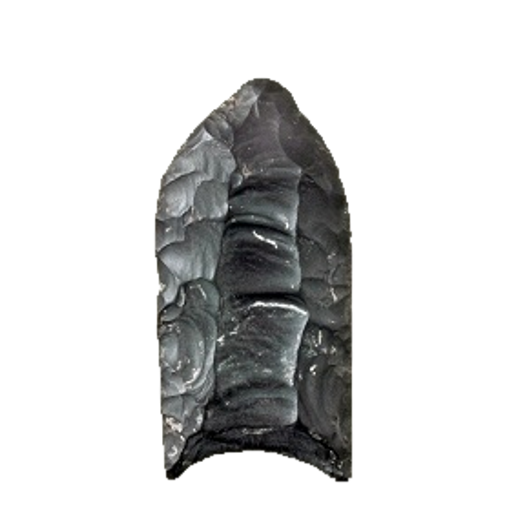
Little Cattail Creek chert is the stone of the Williamson site in Dinwiddie County, Virginia, a Paleoindian quarry and workshop on a plateau above Little Cattail Run in the eastern Fall Zone. It is a mixed material: chert and chalcedony, sometimes laced with yellow and brown jasper. Colours run from white and clear through cream, gray, blue and brown, often variegated, to opaque black, and texture runs from grainy, almost like quartzite, to smooth and waxy. The best pieces are very translucent when freshly broken but weather to light or dark blue or gray. Clovis knappers at Williamson worked it without heating it; later Kirk, Morrow Mountain I and Perkiomen people heat treated it. It turns up east along the Nottoway River toward the Dismal Swamp and north and south along the Fall Line.
How to identify it
- Colour
- White and translucent to opaque black; cream, gray, blue and brown in variegated pieces are most common. One good-quality variety mixes yellow and brown jasper with chert or chalcedony. The classic Williamson chert is variegated cream-blue-gray.
- Texture
- Ranges from grainy, close to quartzite, to smooth and waxy.
- Luster
- Mostly subtranslucent, with several translucent varieties; the best grades are highly translucent when freshly flaked.
- Heat treatment
- Clovis people at Williamson do not seem to have heated it; later Kirk, Morrow Mountain I and Perkiomen knappers did (Virginia DHR).
Where it comes from
Mid-Atlantic
States
Quarries and outcrops
- Williamson site (44DW0001), Little Cattail Creek / Little Cattail Run, about 5 miles east of Dinwiddie, Dinwiddie County, Virginia (eastern Fall Zone)
Used by
- Paleoindian (Clovis): the Williamson quarry-workshop, dated to before about 9000 B.C., yielded fluted points made mainly from the local chert
- Early Archaic (Kirk), Middle Archaic (Morrow Mountain I) and Late Archaic / Transitional (Perkiomen) users heat treated it (Virginia DHR)
Sources
- Egloff. 2008 (updated 2023). Little Cattail Creek Chert. Virginia Department of Historic Resources, Projectile Points and Lithics guide.dhr.virginia.gov (opens in a new tab)
- Virginia Department of Historic Resources. Williamson Archaeological Site (026-0035), Virginia Landmarks Register / National Register of Historic Places listing (VLR 1969, NRHP 1969).dhr.virginia.gov (opens in a new tab)
- Virginia Department of Historic Resources. Clovis. Projectile Points guide.dhr.virginia.gov (opens in a new tab)
- Boyd, C. Clifford. 2020. Paleoindian Period (16,000-8000 BC). Encyclopedia Virginia (Virginia Humanities).encyclopediavirginia.org (opens in a new tab)