Named stone
Liston Creek chert
A kind of chert (and flint)
Liston Creek chertChert (and flint)Midwest/Ohio ValleyDescription
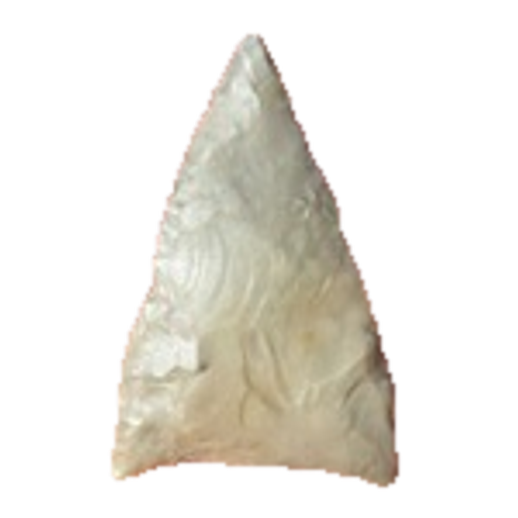
Liston Creek chert is the gray Silurian chert of north-central Indiana, found as nodules and beds in the Liston Creek Limestone Member of the Wabash Formation. Outcrops are in Huntington, Miami and Wabash counties along the upper Wabash. It is always gray, from very light to medium, and weathering can add tan or brown patches, sometimes all in one piece. Texture runs from coarse to medium-fine, with tiny white calcite or silica specks that are probably minute fossils. It is a medium-quality stone whose breakage depends on grain size, yet it was the everyday chert of the region and was used heavily in every precontact period. In one Albee phase burial at the Secrest-Reasoner site, 39 of 42 small triangular arrowheads made by one knapper were Liston Creek chert. Kenneth chert, another Silurian chert, is whiter with gray patches.
How to identify it
- Colour
- Always gray, from very light to medium gray; weathering can add tan or brown patches.
- Texture
- Coarse to medium-fine.
- Inclusions
- Small calcite or siliceous specks, probably tiny fossils.
- Heat treatment
- Heat-treated Liston Creek pieces are reported in Indiana surveys; the colour change is not described in what was opened.
Geology
Nodular and bedded chert in the Liston Creek Limestone Member of the Wabash Formation (Niagaran Series), Silurian System.
Where it comes from
Midwest/Ohio Valley
States
Quarries and outcrops
- Liston Creek Limestone outcrops in Huntington, Miami and Wabash counties, upper Wabash valley, Indiana
Used by
- Used heavily throughout all precontact periods (Wathen and others 2023, citing Cantin 2008:55)
- Late Woodland Albee phase: 39 of 42 triangular (Madison) points from a burial at Secrest-Reasoner (12Bl1), Blackford County (Moore 2024, citing Wright 2003)
- Dominant identified chert (about 44 percent) in a Fulton County survey (Purtill and others 2023)
Look-alikes
Stones that are easy to confuse with Liston Creek chert.
- Kenneth chert (Silurian Salina Formation): white to light gray with gray or brownish-gray patches, medium to low quality
- Fall Creek and Laurel cherts, which Indiana analysts sometimes cannot separate from Liston Creek (categories Fall Creek/Liston and Liston Creek/Laurel)
Sources
- Leeuwrik, Jamie M., Christine Thompson, Shelbi Long, Kevin C. Nolan and Erin Steinwachs. 2015. An Archaeological Survey of Newton County: Enhancement of a Data Deficient Region. Reports of Investigation 88, Vol. 1. Applied Anthropology Laboratories, Ball State University.bsu.edu (opens in a new tab)
- Wathen, Kelli, Christine Thompson and Kevin C. Nolan. 2023. An Archaeological Investigation of the Calvert and Porter Woods Nature Preserve, Montgomery County, Indiana. Indiana Archaeology 16(1):26-44.in.gov (opens in a new tab)
- Purtill, Matthew P., Cecilia M. Szmutko, Hannah Ryker, Carson Wright, Kevin C. Nolan and Christine Thompson. 2023. Archaeological Investigations of Fulton County, Indiana: Summary Results for a FY17 Historic Preservation Fund Survey. Indiana Archaeology 16(1):6-25.in.gov (opens in a new tab)
- Moore, Christopher R. 2024. The Archaeological Significance of Prophetstown State Park. Indiana Archaeology 17(1):6-38.in.gov (opens in a new tab)