Named stone
Green River Formation tiger chert
Also called Tiger chert, Green River Basin tiger chert, Lake Gosiute chert
A kind of chert (and flint)
Green River Formation tiger chertChert (and flint)Rockies & Great BasinDescription
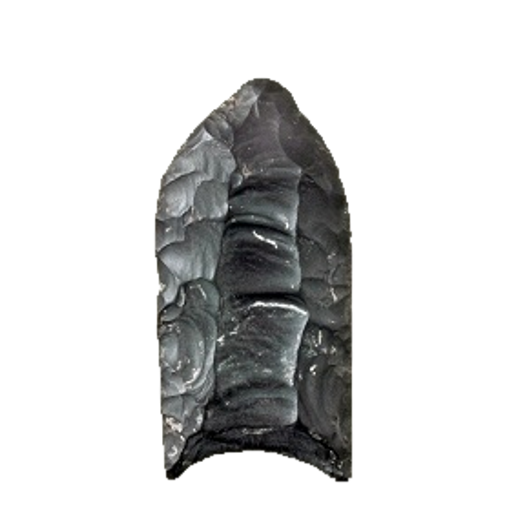
Tiger chert is a banded, brown-and-tan chert from the Green River and Great Divide basins of southwestern Wyoming. It formed in the beds of Eocene Lake Gosiute, where silica cemented the sand, silt and clay of the lake bottom or filled voids left by dissolved shells. The Wyoming State Geological Survey says the alternating dark and light brown or tan bands reflect yearly layers of sediment, and that the stone is homogeneous, ideal for finely flaked tools. Outcrops lie southwest of Rock Springs and at a few other places in the Green River Basin. About 13,000 years ago Clovis knappers made points up to about 8 inches long and very thin from it. Caches of such tools turn up as far as Boulder, Colorado, and the Black Hills, and some were coated with red ocher.
How to identify it
- Colour
- Alternating bands of dark and lighter brown or tan (Wyoming State Geological Survey).
- Texture
- Homogeneous, glass-like, well suited to finely flaked tools.
Geology
Lake-bottom sediment of Eocene Lake Gosiute (56 to 33.9 million years ago) cemented by silica in the Green River and Great Divide basins. In places silica bound the grains; in others it filled voids left by dissolved shells. Erosion has exposed the layers, which form hard pavements on the basin floors.
Where it comes from
Rockies & Great Basin
States
Quarries and outcrops
- Southwest of Rock Springs, Green River Basin, Wyoming
- Great Divide (Red Desert) Basin
Used by
- Clovis (about 13,000 years ago): points and bifaces, including caches as far away as Boulder, Colorado, and the Black Hills
- All later periods: the stone occurs in archaeological sites of all ages
Look-alikes
Stones that are easy to confuse with Green River Formation tiger chert.
- Other Green River Basin cherts (a variety of 'glass-like rocks' that the Survey says were extensively used)
Sources
- Wyoming State Geological Survey. Guide to the Green River Basin (Cultural Geology series).main.wsgs.wyo.gov (opens in a new tab)