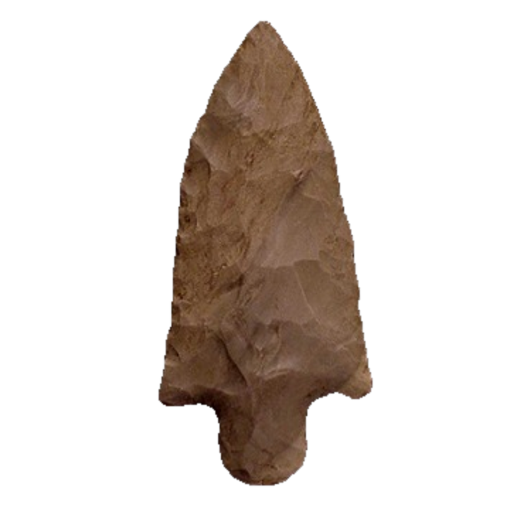
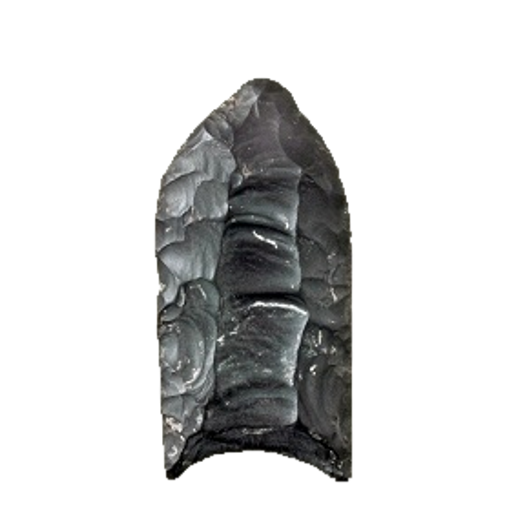
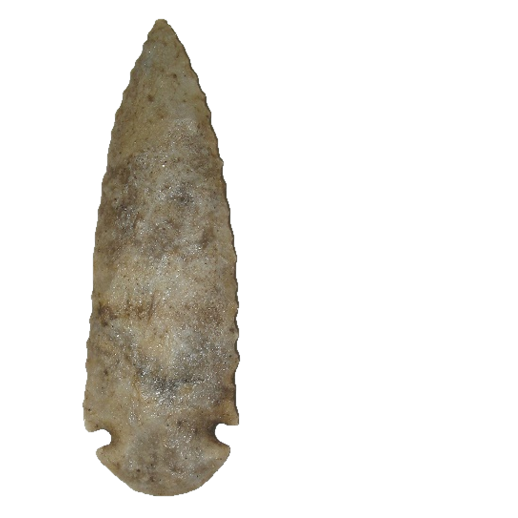
Named stone
Flint Ridge flint
Also called Vanport flint (the geological name)
A kind of chert (and flint)
Flint Ridge flintChert (and flint)Midwest/Ohio Valley2 photos
Description
Flint Ridge flint is Ohio's most famous and colourful flint. It comes from the Pennsylvanian-age Vanport flint, which crops out on a ridge of about six square miles in eastern Licking and western Muskingum counties. Colours include blue, gray, red, brown, yellow and white, with rarer green, bright yellow, purple and swirled, streaked or mottled forms; much of it is translucent blue chalcedony and some is banded jasper. It was quarried for more than 12,000 years. Adena and Hopewell peoples (Hopewell 150 B.C. to A.D. 450) quarried it for tools and ceremonial pieces and traded it with groups across the region. The ancient pits are preserved at Flint Ridge State Memorial.
How to identify it
- Colour
- Very variable: blue, gray, red, brown, yellow and white; rarer green, bright yellow, red, blue and purple; swirled, streaked and mottled mixes; some banded or ribbon jasper. Colour comes from iron, manganese and carbon-rich impurities and from weathering.
- Texture
- Much of it is chalcedony, a dense fibrous microcrystalline quartz, often blue or grayish blue and translucent.
- Inclusions
- Some Vanport flint carries quartz crystals.
Geology
Vanport flint, a bed in the Vanport Member of the Pennsylvanian, 1 to 12 feet thick and discontinuous. The Ohio Geological Survey explains that most nodular chert forms when silica replaces limestone, and bedded chert when carbonate beds are fully replaced or when siliceous ooze (partly from sponge spicules) is altered; the exact silica source is not settled.
Where it comes from
Midwest/Ohio Valley
States
Quarries and outcrops
- Flint Ridge, Licking and Muskingum counties (Flint Ridge State Memorial)
- Nethers flint quarries, Flint Ridge
- Other Ohio flints of the same age: Upper Mercer (Coshocton, Hocking and Perry counties) and Zaleski (Vinton and Jackson counties)
Used by
- Paleoindian onward (quarried for more than 12,000 years)
- Adena (about 850-50 B.C.)
- Hopewell (150 B.C. to A.D. 450): quarrying and wide trade
Look-alikes
Stones that are easy to confuse with Flint Ridge flint.
- Upper Mercer flint (Ohio; black to dark gray, fossil flecks)
- Zaleski flint (Ohio, Pennsylvanian)
- Plum Run flint (Ohio; mostly blue-gray, a different trace-element signature)
Sources
- Getz, Garry L. 2016 (rev.). Flint: Ohio's Official Gemstone. Educational Leaflet No. 6. Ohio Department of Natural Resources, Division of Geological Survey.dam.assets.ohio.gov (opens in a new tab)
- Boulanger, Matthew T. 2022. Neutron Activation Analysis and X-ray Fluorescence of Chert Artifacts from Mielke #1 (33SH26). Supplementary Text S1, Midcontinental Journal of Archaeology.midwestarchaeology.org (opens in a new tab)