
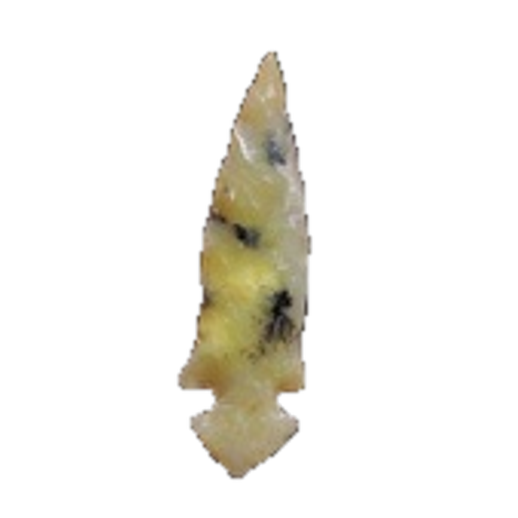
Arrowhead type
Klickitat Point
Klickitat300 - 160 B.P.Historic18 reference photos
Key facts
- Age
- 300 - 160 B.P.
- Cultural period
- Historic
- Culture
- Klickitat Culture
- Size
- Small
- Shape
- Straight Stem to Expanding Stem to Contracting Stem to Side Notch
- Glacial period
- Little Ice Age to Modern Times
More from the Historic period
Description
This slender, triangular point features a distinctive elliptical cross-section and a narrow, elongated blade that can exhibit a range of curvature, from excurvate to recurvate, with a pronounced inward curve at the tip and an outward flare at the shoulders. The shoulders themselves can be oriented horizontally or display a slight barbing. The stem is typically characterized by a subtle expansion, although some specimens may have a straight stem. The base of the point is often pointed, imparting a diamond-like shape to the stem, but can also be convex in shape. Notably, these points are often crafted with precision, displaying a flaking pattern that can vary from random to parallel oblique, underscoring the skill of their manufacture.
Size
The dimensions of the arrowheads are as follows: overall length ranges from 19 to 46 mm, while the stem measures between 5 to 9 mm in length. The neck width is recorded to be between 3 to 5 mm, and the maximum width of the stem falls within the range of 4 to 7 mm.
Distribution
This type is mainly discovered in the Columbia River basin and its branches from the Cowlitz river to the Yakima River
Mainly found in
Additional information
In the realm of Native American arrowhead typology, distinct morphological characteristics serve as a basis for classification. Notably, arrowheads exhibiting a diamond-shaped form are categorized as belonging to the Klickitat type. This designation is significant, as it highlights the unique geometric features of these points. Conversely, arrowheads characterized by a rectangular stem are classified as Dagger type points, underscoring the importance of stem morphology in the typological framework. By recognizing these differences, archaeologists can better understand the technological and cultural nuances of various Native American groups, ultimately shedding light on the complexities of their lithic traditions.
The Klickitat and Dagger types represent distinct point styles, each with its own set of characteristics that set it apart from other types. The diamond-shaped form of Klickitat points is a notable feature, one that has been used to identify and classify these artifacts in various archaeological contexts. Similarly, the rectangular stem of Dagger type points serves as a diagnostic trait, allowing researchers to distinguish these points from others with differing stem morphologies. By examining these characteristics, archaeologists can gain insight into the lives and traditions of the people who created these points, including their technological expertise, cultural exchange networks, and subsistence strategies.
The classification of arrowheads into types such as Klickitat and Dagger is crucial for understanding the diversity and complexity of Native American lithic technologies. By recognizing and analyzing these types, researchers can reconstruct the cultural and historical contexts in which they were created, ultimately contributing to a more nuanced understanding of the lives and traditions of Native American communities. Furthermore, the study of arrowhead typology highlights the importance of considering the technological, social, and cultural factors that shaped the development of lithic technologies in various regions and time periods, providing a rich and multifaceted perspective on the history and cultural heritage of Native American societies.
Identified by
- Named by
- W. Duncan Strong
- Year
- 1930
- Type site
- Miller Island, Columbia River, Klickitat County, Washington
Similar types
Types that are easy to confuse with the Klickitat point.
- Calapooya
- Columbia Plateau
- Rabbit Island
- Wallula Gap