
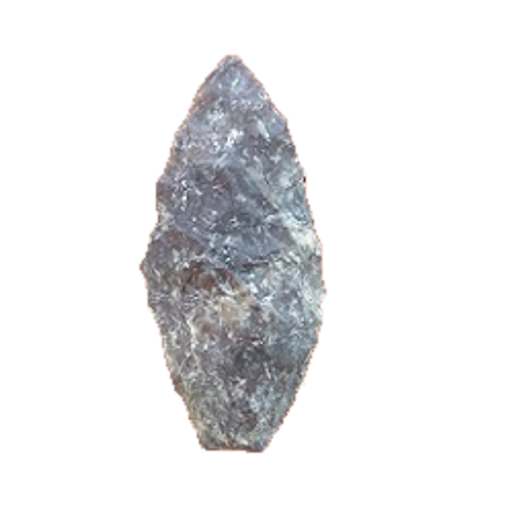
Arrowhead type
Greene Point
Greene1,700 - 1,200 B.P.Late Woodland2 reference photos
Key facts
- Age
- 1,700 - 1,200 B.P.
- Cultural period
- Late Woodland
- Size
- Medium
- Shape
- Lanceolate to Ovoid
- Material
- Felsite
- Glacial period
- Roman Warm to Vandal Minimum
More from the Woodland period
Description
This artifact exhibits a distinctive morphology, characterized by a medium-sized lanceolate to pentagonal profile with an elliptical cross-sectional shape. The blade itself is notably broad, displaying a predominantly excurvate curvature, and often assumes a pentagonal form, where the maximum width is typically situated between the midpoint and the lower third of the point's length. The basal edge is marked by a straight alignment. In terms of flaking pattern, this point features a random arrangement of flake scars, indicating a non-patterned approach to its manufacture.
Size
The dimensions of the arrowheads are characterized by a length range of 35 to 70 mm, with a typical average length falling between 40 to 50 mm. In terms of width, the measurements span from 20 to 30 mm, with an average width of 25 mm.
Distribution
This type frequently linked to the Hudson River Valley and the shoreline areas of Massachusetts, extending into Vermont, Connecticut, and New Hampshire
Additional information
More information needed.
Identified by
- Named by
- Robert E. Funk and William Ritchie
- Year
- 1971
- Type site
- A
Similar types
Types that are easy to confuse with the Greene point.