
Arrowhead type
Graceros Point
Graceros1,800 - 650 B.P.Transitional Archaic to Classic3 reference photos
Key facts
- Age
- 1,800 - 650 B.P.
- Cultural period
- Transitional Archaic to Classic
- Culture
- Guadiana Chalchihuites and Loma San Gabriel Cultures
- Size
- Small to Medium
- Shape
- Side Notch to Expanding Stem
- Glacial period
- Roman to Medieval Warm
More from the Archaic, Preclassic and Classic periods
Description
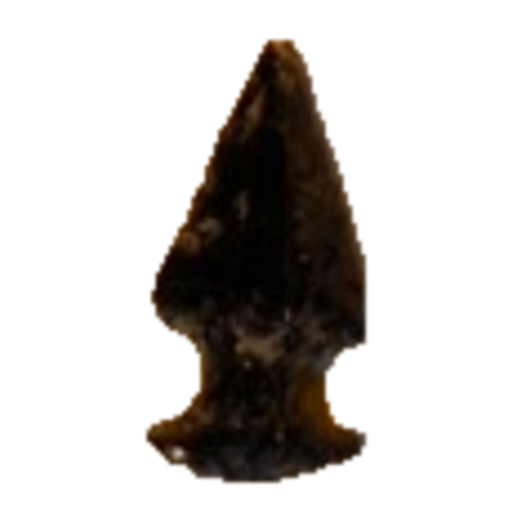
This triangular point features a slender, oval-shaped cross-section and exhibits a pronounced excurvate blade profile. The side notches are positioned near the base of the blade, creating a shoulder that ranges from horizontal to slightly inclined. The stem is characterized by an expanded shape, a convex base, and rounded basal corners, which impart a distinctive "rocker" morphology to the base. The flaking pattern on this point is irregular and non-directional, lacking a discernible pattern.
Size
The arrowhead's dimensions are characterized by a length range of 20 to 25 millimeters, with a mean length of 24 millimeters. The blade's width spans 10 to 15 millimeters, averaging 13 millimeters. In terms of thickness, the measurements fall between 3 and 5 millimeters, with an average thickness of 4 millimeters.
Distribution
These artifacts are mainly located in the Loma and Guadiana Chalchihuites cultural areas of Chihuahua, Durango, Zacatecas, San Luis Potosi, Jalisco, and Aguascalientes Mexico.
Mainly found in
Additional information
In a comparative analysis, the arrowhead in question bears a striking resemblance to the Cruz de la Boca side notch type, albeit on a smaller scale. This observation is supported by the research of Spence, published in 1971, which provides a foundational framework for understanding the morphological characteristics of this particular point style. The diminutive size of this arrowhead is a notable characteristic, distinguishing it from its larger counterparts within the Cruz de la Boca side notch category.
The Cruz de la Boca side notch is a significant archaeological find, offering valuable insights into the technological and cultural practices of the Native American groups that crafted these points. By examining the size variation within this type, researchers can gain a deeper understanding of the adaptive strategies and functional requirements that influenced the design and manufacture of these artifacts. The smaller size of this particular point may indicate a specific use or cultural context, highlighting the importance of continued research and analysis to fully elucidate its significance.
Further study of this arrowhead, in conjunction with other examples of the Cruz de la Boca side notch type, can provide a more nuanced understanding of the cultural and historical contexts in which they were created. The work of Spence (1971) serves as a crucial reference point for this investigation, offering a foundation for the identification and interpretation of these important archaeological artifacts. By building upon this research, scholars can continue to refine our understanding of Native American technological and cultural developments, shedding new light on the lives and traditions of these ancient communities.
Identified by
- Named by
- Michael W. Spence
- Year
- 1971
Similar types
Types that are easy to confuse with the Graceros point.