
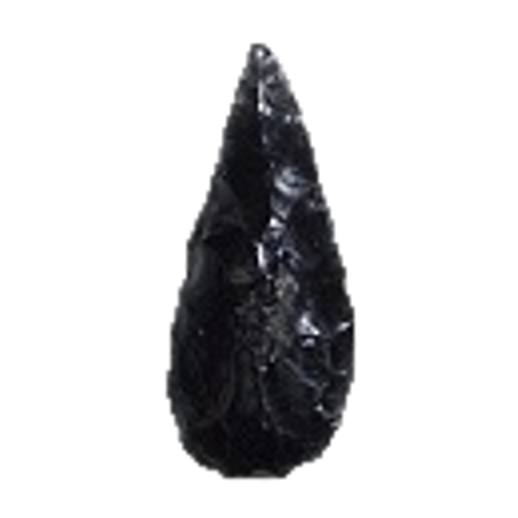
Arrowhead type
Gold Hill Point
Gold Hill4,000 - 2,000 B.P.Late ArchaicKey facts
- Age
- 4,000 - 2,000 B.P.
- Cultural period
- Late Archaic
- Size
- Small to Medium
- Shape
- Ovoid
- Material
- Obsidian
- Glacial period
- Neoglacial to Roman Warm
More from the Archaic period
Description
This ovoid point measures between 0.9 and 1.4 inches in length, exhibiting a compact, elliptical profile. The blade's curvature is characterized by an excurvate shape, where the tip is reflexed inward, while the maximum width is achieved at a point approximately one-third to one-half of the way down the blade, before narrowing towards the base. The basal margin is marked by a convex shape. The flaking pattern observed on this point is random, lacking a discernible or deliberate arrangement of flakes.
Size
The arrowheads exhibit the following dimensional characteristics: in terms of length, they range from 24mm to 35mm, with a mean measurement of 29.7mm. The width varies between 12mm and 16mm, averaging 14.3mm. Thickness measurements fall within a range of 4mm to 7mm, with a mean thickness of 5.5mm.
Distribution
This type is mainly discovered in Oregon's Rouge River Valley and stretches into northern California, reaching the shoreline areas of southern Oregon and Northern California
Mainly found in
Additional information
In the realm of Native American arrowhead typology, a specific type bears resemblance to the Malaga Cove, Excelsior, and McKee Uni-face types, yet exhibits distinct characteristics that set it apart. According to Justice (2002), despite the shared use of pressure flaking techniques among these types, notable differences in overall size, shape, and flake removal patterns justify their classification as separate entities. This distinction highlights the complexity and nuance of arrowhead typology, where subtle variations in manufacturing techniques and morphological features can significantly impact our understanding of these ancient artifacts.
A closer examination of these types reveals that while they may appear similar at first glance, each possesses unique attributes that reflect the ingenuity and craftsmanship of their creators. The Malaga Cove, Excelsior, and McKee Uni-face types, for instance, demonstrate distinct flake removal patterns, which suggest differences in the tools and techniques employed by their manufacturers. Furthermore, variations in size and shape among these types may indicate differences in their intended uses or the preferences of their creators. By recognizing and appreciating these subtle differences, researchers can gain a deeper understanding of the cultural and historical contexts in which these arrowheads were produced.
The work of Justice (2002) underscores the importance of meticulous analysis and classification in the study of Native American arrowheads. By acknowledging the distinct characteristics of each type, researchers can reconstruct a more accurate and detailed picture of the technological, social, and cultural developments that shaped the lives of Native American communities. As our understanding of these ancient artifacts continues to evolve, it is essential to approach their study with a nuanced and discerning perspective, recognizing both the similarities and differences that define these remarkable examples of Native American ingenuity and craftsmanship.
Identified by
- Named by
- Luther S. Cressman
- Year
- 1933
- Type site
- Gold Hill Site (on the Rouge River), Jackson county, Oregon
Similar types
Types that are easy to confuse with the Gold Hill point.
- Cascade
- Cottonwood Leaf
- Excelsior
- Malaga Cove
- McKee
- Trojan