
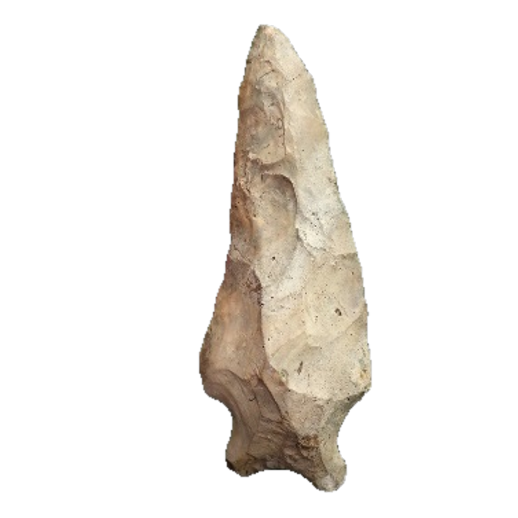
Arrowhead type
Gadsden Lobed Point
Gadsden Lobed2,100 - 1,200 B.P.Middle Woodland to Early Mississippian2 reference photos
Key facts
- Age
- 2,100 - 1,200 B.P.
- Cultural period
- Middle Woodland to Early Mississippian
- Culture
- Swift Creek to early Weeden Island Culture
- Size
- Medium
- Shape
- Expanding Stem to Bifurcated to Side Notch
- Glacial period
- Roman Warm to Vandal Minimum
More from the Woodland, Mississippian periods
Description
This artifact exhibits a triangular form with a length spanning 2.25 to 3.5 inches, characterized by an elliptical profile. The blade's curvature is outward, displaying an excurvate shape. The shoulders of the point are positioned either horizontally or at a slight, upward inclination. Notably, the stem is concise and expands outward, terminating in a base that is either concave or bifurcated. The basal edges are smoothed, forming rounded protrusions that resemble lobes. The overall craftsmanship of this point is of high quality, featuring a flaking pattern that appears random and lacking any discernible order.
Size
The dimensions of the arrowheads are as follows: they range in overall length from 55 to 95 mm, with stem lengths varying between 14 and 19 mm. The width of the arrowheads spans from 25 to 40 mm, while the stem width measures between 20 and 35 mm. Additionally, the neck width falls within the range of 15 to 25 mm, and the thickness of the arrowheads is between 7 and 10 mm.
Distribution
This type is mainly discovered ranging from the Ochlockonee river eastward to northwestern parts of Florida.
Additional information
In the realm of Native American archaeology, a distinct subtype of the Brower type has been identified and classified as the Brower Variant 1. This designation was formally introduced by Granger and Granger in their 2013 publication, providing a framework for understanding the nuances of this particular arrowhead style. The Brower Variant 1 is characterized by a unique combination of traits that set it apart from other Brower-type arrowheads, and its study has shed valuable light on the technological and cultural developments of the Native American groups that crafted these artifacts.
For a more in-depth examination of the Brower Variant 1, researchers and enthusiasts can consult the online resources provided by the Florida Museum of Natural History, specifically the webpage dedicated to the Bullen collection at the University of Florida (http://www.flmnh.ufl.edu/flarch/bullen/gadsden.htm). This digital repository offers a wealth of visual information, featuring photographs of multiple examples that illustrate the diagnostic features and variability within the Brower Variant 1 subtype. By exploring these resources, scholars can gain a deeper appreciation for the intricacies of Native American arrowhead typology and the significance of the Brower Variant 1 within the broader context of archaeological research.
The recognition of the Brower Variant 1 as a distinct subtype underscores the importance of meticulous classification and documentation in archaeology. By refining our understanding of these ancient artifacts, researchers can reconstruct the cultural, social, and technological practices of Native American communities with greater accuracy, ultimately enriching our knowledge of the region's rich and complex cultural heritage. As such, the study of the Brower Variant 1 serves as a testament to the ongoing efforts of archaeologists to illuminate the past and promote a deeper appreciation for the history and traditions of Native American societies.
Identified by
- Named by
- Ripley P. Bullen
- Year
- 1975
Similar types
Types that are easy to confuse with the Gadsden Lobed point.