
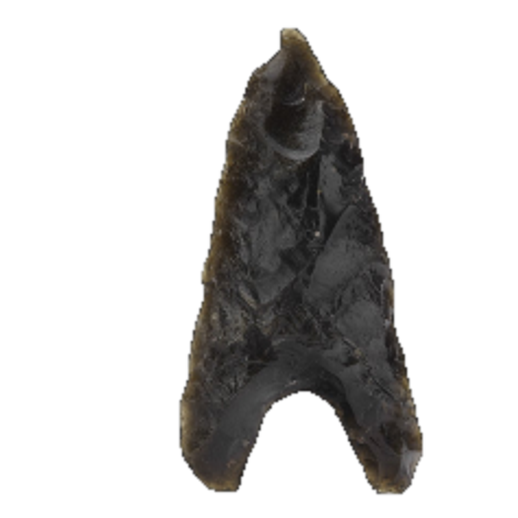
Arrowhead type
Flacco Point
Flacco6,800 - 4,000 B.P.Early Archaic to Middle Archaic4 reference photos
Key facts
- Age
- 6,800 - 4,000 B.P.
- Cultural period
- Early Archaic to Middle Archaic
- Size
- Medium to Large
- Shape
- Lanceolate
- Glacial period
- Middle Holocene
More from the Archaic period
Description
This medium-sized lanceolate point exhibits a distinctive elliptical profile in cross-section. The blade's curvature is characterized by an excurvate shape, with the tip sweeping inward. In some instances, the blade edges converge towards the base, yielding a quintessential lanceolate silhouette, while in others, the outline assumes a triangular or pentagonal form. The base is marked by a pronounced concavity, often accompanied by basal ears that resemble spurs or barbs, which can range from a V-shaped to a deeply U-shaped configuration. The hafting area frequently displays extensive grinding, including basal grinding and the removal of thinning flakes, which facilitates a secure attachment. The manufacturing process involves an initial stage of percussion flaking to shape the preform, followed by a secondary stage of refined percussion flaking or pressure flaking to achieve the final form. The resulting flaking pattern is typically random, although collateral flaking is occasionally observed, adding a touch of complexity to the point's overall morphology.
Size
The dimensions of the arrowheads are as follows: they range in length from 32 to 57 mm, with a mean length of 42 mm. The width varies between 18 and 33 mm, averaging 28 mm. In terms of thickness, the measurements span from 6 to 13 mm, with an average of 9 mm. Additionally, the basal concavity is measured between 3 and 9 mm, with a mean of 6 mm, as reported by MacNeish in 1967.
Distribution
This type is mainly discovered in Mexico's Tehuacan Valley region. Discoveries have been made at Hidalgo's Tecolota Cave, Querertaro's San Nicoles Cave, and surface discoveries in Tamaulipas' southern area and the Valley of Mexico
Mainly found in
Additional information
In the realm of Native American arrowhead studies, the Flacco point represents a later development in the evolution of projectile point technology. Notably, research suggests that the Flacco point emerged as a successor to the earlier El Riego point style, as first proposed by MacNeish in 1967. This chronological relationship implies a gradual refinement of design and functionality over time, with the Flacco point likely incorporating innovations and improvements built upon the foundation established by its El Riego predecessors. By examining the morphological and technological characteristics of these points, archaeologists can gain valuable insights into the cultural and historical contexts in which they were created and utilized.
Identified by
- Named by
- Richard "Scotty" MacNeish
- Year
- 1961
Similar types
Types that are easy to confuse with the Flacco point.