
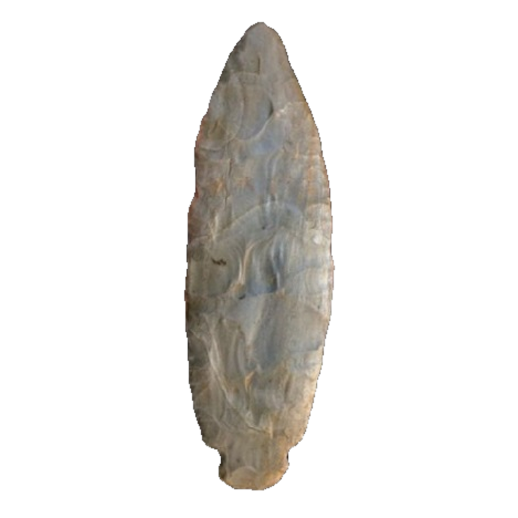
Arrowhead type
Early Ovoid Knife
Early Ovoid Knife11,000 - 8,000 B.P.Transitional Paleo to Early Archaic18 reference photos
Key facts
- Age
- 11,000 - 8,000 B.P.
- Cultural period
- Transitional Paleo to Early Archaic
- Size
- Medium to Large
- Shape
- Side Notch to Ovoid
- Glacial period
- Early Holocene
Description
This ovoid knife exhibits a substantial size range, characterized by an elliptical profile in cross-section. The blade's curvature is notably excurvate, with a pronounced inward bend at the distal tip and a recurved shape that sweeps back towards the proximal base. The shoulders display a range of morphologies, from subtly barbed to exhibiting a pronounced upward inclination. The stem expands in width, terminating in a base that can be straight, convex, or pointed. The flaking pattern observed on this point is random, lacking a discernible or systematic arrangement of flake scars.
Size
The dimensions of the arrowheads are as follows: they range in overall length from 70 to 290 mm, with stem lengths varying between 10 and 25 mm. The width of the blade spans from 30 to 65 mm, while the neck width measures between 10 and 23 mm. Additionally, the stem width is recorded to be between 18 and 28 mm.
Distribution
This type is mainly linked to Kentucky and extends into the Ohio River Basin and the central Mississippi River Basin
Additional information
In the realm of Native American lithic artifacts, a particular type of knife exhibits two distinct morphological variations. The first form is characterized by the presence of prominent shoulders, which are accompanied by an expanding stem that broadens as it approaches the base. Notably, the base of this knife form can range from being straight to convex in shape, showcasing a degree of variability within this specific type.
In contrast, the second form of this knife presents a bi-pointed configuration, with a distinctive feature being the presence of notches located towards the base of the artifact. This bi-pointed form offers an interesting insight into the technological and stylistic diversity of Native American toolmaking traditions. The coexistence of these two forms highlights the complexity and nuance of prehistoric tool design, where different forms may have been preferred or utilized for specific tasks or cultural contexts.
The existence of these two forms underscores the importance of considering the functional, cultural, and historical contexts in which these knives were created and used. By examining the morphological characteristics of these artifacts, researchers can gain a deeper understanding of the technological and social developments of Native American communities, ultimately enriching our knowledge of the cultural and historical landscape of North America.
Identified by
- Named by
- Gregory Perino
- Year
- 1976
Similar types
Types that are easy to confuse with the Early Ovoid Knife point.