
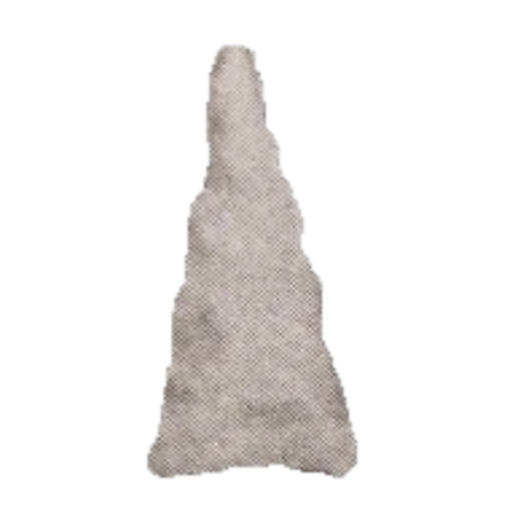
Arrowhead type
Durango Triangle Point
Durango TriangleLate Southern Triangle Cluster1,450 - 1,050 B.P.PreclassicKey facts
- Age
- 1,450 - 1,050 B.P.
- Cultural period
- Preclassic
- Culture
- Llano Grande, Guadiana Chalchihuites,and Loma San Gabriel Cultures
- Size
- Small to Medium
- Shape
- Triangle
- Glacial period
- Vandal Minimum
More from the Preclassic and Classic period
Description
The artifact presents as a compact, triangular point, characterized by a slender, oval-shaped cross-sectional profile. Its blade exhibits a subtle outward curvature, broadening noticeably towards the base. The basal margin is marked by a gentle concavity, accentuated by pronounced basal corners that define its outline. The flaking pattern observed on this point is irregular and non-directional, lacking a discernible sequence or orientation, which is indicative of a random flaking technique.
Size
The dimensions of the arrowheads are as follows: they typically range in length from 35 to 41 millimeters, with a mean length of 38 millimeters. The width of the blade varies between 12 and 34 millimeters, averaging 22 millimeters. In terms of thickness, the measurements span from 3 to 8 millimeters, with an average thickness of 5 millimeters.
Distribution
These artifacts were discovered alongside settlements from the Llano Grande, Loma San Gabriel, and Guadiana Chalchihuites civilizations. the traditional territories of Chihuahua, Durango, Sonora, Sinloa, Nayarit, Zacatecas, San Luis Potosi, Jalisco, and Aguascalientes Mexico.
Mainly found in
Additional information
More information needed.
Identified by
- Named by
- James L. Dykman
- Year
- 1976
- Type site
- Abajo Site (29SJ116), San Juan County, New Mexico
Similar types
Types that are easy to confuse with the Durango Triangle point.
- Adams Triangle
- Atotonilco Triangle
- Early Triangle
- Hohokam Knife
- Loma Concave Base
- Matamoros
- Mescal Knife
- Navacovan Concave Base
- Tortugas