
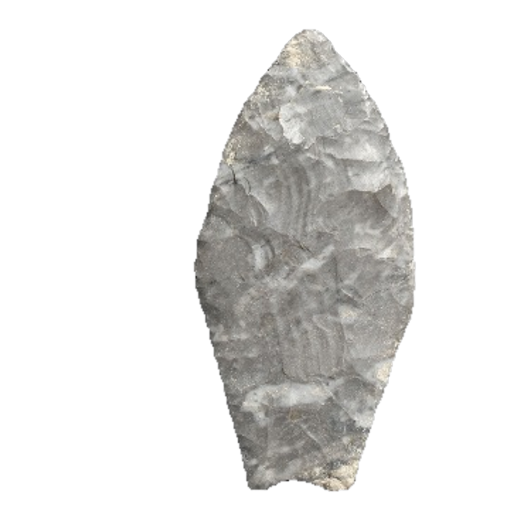
Arrowhead type
Crowfield Fluted Point
Crowfield FlutedClovis Cluster11,000 - 10,000 B.P.Transitional Paleo2 reference photos
Key facts
- Age
- 11,000 - 10,000 B.P.
- Cultural period
- Transitional Paleo
- Size
- Medium
- Shape
- Lanceolate
- Material
- Chert
- Glacial period
- Late Pleistocene
More from the Paleo period
Description
This medium-sized lanceolate point exhibits a slender profile, characterized by a cross-sectional shape that transitions from flattened to elliptical. The blade's curvature is pronounced, with an excurvate shape that contracts towards the tip and then expands outward before converging again at the base. The maximum blade width is concentrated in the upper one third to one half of the point. A concave base gives rise to small, pointed basal ears that are oriented downward, distinguishing these points from those with a "fishtail" morphology. Each face of the point features two to three flutes, which extend approximately half to three quarters of the way down the length of the point, broadening as they approach the base. The base is refined with smaller, delicate flakes that thin out the basal area. Both basal and lateral surfaces exhibit light grinding. The flaking pattern is predominantly collateral, with flakes terminating at varying points along the midline, rather than converging at a single point. In contrast, re-sharpened points often display a parallel flaking pattern, sometimes accompanied by a "chevron" pattern near the base.
Size
The dimensions of the arrowheads are characterized by the following metrics: length ranges from 40 to 65 mm, with a mean length of 54 mm. The width varies between 22 and 35 mm, averaging 30.8 mm. In terms of thickness, the measurements fall between 3 and 5 mm, with a mean thickness of 4.6 mm. The basal width spans from 13 to 23 mm, with an average of 17.9 mm. Basal concavity is observed to range from 0.5 to 4 mm, with a mean of 2.1 mm. The thickness-to-width ratio is calculated to be between 5:1 and 8:1.
Distribution
This type is mainly located in the Great Lakes area. It has also been discovered in Vermont, and occasionally in Ohio and Michigan
Also found, less often, in
Additional information
The archaeological record suggests that a particular type of projectile point represents the final iteration of fluted forms, with a chronological placement between 10,500 and 10,400 years before present (B.P.). This timeframe is significant, as it marks the tail end of a technological tradition that was once prevalent among ancient Native American cultures. The points in question, designated as W14, are characterized by their distinctive fluted morphology, which was a hallmark of earlier periods. However, their appearance at this relatively late date indicates a lingering persistence of traditional manufacturing techniques, even as other cultural and technological innovations were beginning to emerge.
Notably, the W14 points demonstrate a remarkable consistency in terms of their stylistic and metric attributes, which has allowed researchers to pinpoint their chronological position with a relatively high degree of accuracy. The fact that these points are found within a narrow temporal window, spanning just 100 years, underscores the dynamic nature of cultural and technological evolution during this period. As such, the W14 points serve as an important benchmark for understanding the complexities of Native American cultural development, particularly during the terminal stages of the Paleoindian period.
From a broader archaeological perspective, the W14 points offer valuable insights into the lives and traditions of ancient Native American communities. Their fluted design, although reminiscent of earlier forms, likely reflects a continued emphasis on hunting and foraging practices that were well-suited to the environmental conditions of the time. As researchers continue to study these points, they may uncover additional clues about the social, economic, and technological contexts in which they were created, ultimately shedding new light on the rich cultural heritage of Native American societies during this pivotal moment in their history.
Identified by
- Named by
- D. Brian Deller and Christopher J. Ellis
- Year
- 1984
- Type site
- Crowfield, Southwestern Ontario, Canada
Similar types
Types that are easy to confuse with the Crowfield Fluted point.