
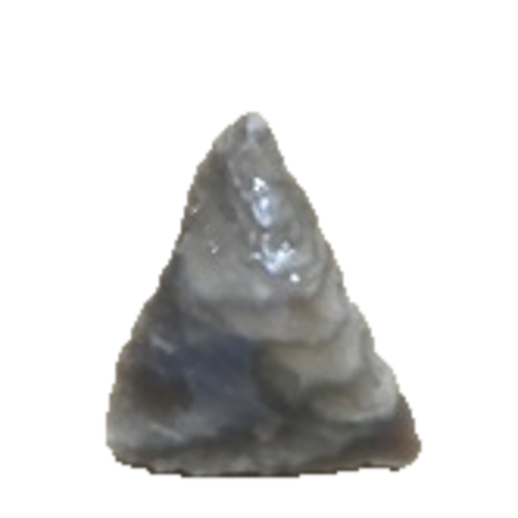
Arrowhead type
Cottonwood Triangular Point
Cottonwood TriangularWestern Triangle Cluster900 - 200 B.P.Developmental to Historic15 reference photos
Key facts
- Age
- 900 - 200 B.P.
- Cultural period
- Developmental to Historic
- Culture
- Fremont, Paiute, Cohonina, Luiseno Chumash, Cultures
- Size
- Small
- Shape
- Triangle
- Glacial period
- Medieval Warm to Little Ice Age
More from the Developmental, Historic periods
Description
This triangular point exhibits a slender profile, characterized by a compressed cross-sectional morphology. Its overall form can fluctuate between an isosceles configuration, where the height is roughly twice the width, and an equilateral configuration, where the height and width are approximately equal. The blade's curvature varies, with excurvate forms being most prevalent, although straight and incurvate blades also occur. The basal margin displays a range of curvature, from subtly concave to subtly convex. The flaking pattern on this point is characterized by a non-directional, random arrangement of flake scars.
Size
The arrowheads exhibit a range of dimensions, with overall lengths spanning from 11 to 53 mm, and averaging between 21 to 25 mm. In terms of width, they measure between 6 to 18 mm, with an average width of 10 to 13 mm. The thickness of these arrowheads averages between 3 to 5 mm.
Distribution
This type is distributed across the Great Basin, Colorado Plateau, the Southwest Region and California. Occurrences have been documented in northern Baja California and northwestern Mexico
Additional information
The cache type of arrowheads encompasses a diverse range of variations, showcasing the ingenuity and adaptability of Native American craftsmanship. Notably, the triangular forms exhibit a wide range of base shapes, including isosceles triangles with straight, concaved, and convex bases, as well as equilateral triangles. Furthermore, the blades themselves display an equally impressive array of variations, with shapes ranging from incurvate to excurvate, demonstrating the resourcefulness and skill of the artisans who created them. Despite this complexity, researchers have not yet undertaken a comprehensive effort to subclassify this type based on distinct flaking techniques or materials, as observed by Justice in 2002. This lack of subdivision underscores the need for further study and analysis to fully appreciate the nuances and characteristics of this arrowhead type.
Identified by
- Named by
- Edward Lanning
- Year
- 1963
- Type site
- Cottonwood Site, Inyo County, California
Similar types
Types that are easy to confuse with the Cottonwood Triangular point.
- Aguaje
- Archaic Triangle
- Bull Creek
- Canalino
- Fresnito
- Gunther Triangle
- Plains Triangle
- Sobaipuri
Other types in the Western Triangle Cluster
- Cohonina
- Cottonwood Leaf
- Price Ranch