
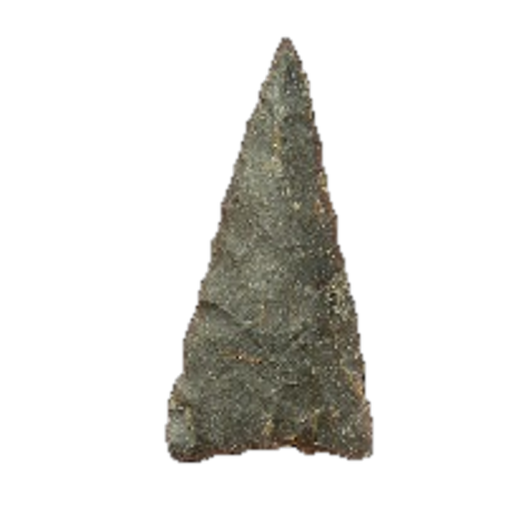
Arrowhead type
Plains Triangle Point
Plains TrianglePlains Triangular Cluster1,000 - 500 B.P.Developmental14 reference photos
Key facts
- Age
- 1,000 - 500 B.P.
- Cultural period
- Developmental
- Size
- Small
- Shape
- Triangle
- Material
- Bone
- Glacial period
- Medieval Warm to Little Ice Age
More from the Developmental period
Description
This diminutive triangular point, measuring between 1 to 1.5 inches in length, exhibits a slender profile with a compressed cross-sectional morphology. The blade edge is predominantly linear, although it may occasionally display a subtle excurvate curvature. The basal margin varies from a straight alignment to a faintly concave outline, characterized by sharp, well-defined corners. The flaking pattern observed on this point is irregular and non-directional, lacking a discernible pattern or orientation.
Size
The arrowheads exhibit a range of dimensions, with lengths spanning from 10mm to 36mm, and a mean length of 25mm. In terms of width, the measurements fall between 10mm and 26mm, with an average width of 15.7mm. The thickness of the arrowheads varies from 2mm to 5mm, with a mean thickness of 2.9mm.
Distribution
This projectile is linked to mobile bison hunters of the grasslands and open ranges. It is discovered from the open areas of Saskatchewan and Alberta to the grasslands of Montana, North and South Dakota. It may also appear in the open regions of Colorado, Nebraska, and Kansas. The greatest densities of these projectiles are discovered in the southern area of the grasslands, indicating a Mississippian cultural impact (Drager and Ireland (1986))
Also found, less often, in
Additional information
In a seminal study published in 1954, renowned archaeologist Richard MacNeish conducted a thorough analysis of the projectile points unearthed at the Stott Site. His research yielded a distinctive array of four projectile point types, each with its own unique characteristics. Specifically, MacNeish's findings included the presence of Plains Triangular, Plains Side Notch, Prairie Side Notch, and Stott Corner Notch point types. These classifications provide valuable insights into the technological and cultural practices of the site's ancient inhabitants, highlighting the diversity of projectile point styles employed by Native American groups in the region. By examining the morphological features and distribution of these point types, researchers can gain a deeper understanding of the site's occupational history and its place within the broader cultural landscape of the Plains region.
Identified by
- Named by
- Richard "Scotty" MacNeish
- Year
- 1954
- Type site
- Stott Mound and Village, Manitoba, Canada
Similar types
Types that are easy to confuse with the Plains Triangle point.
- Archaic Triangle
- Cottonwood Triangle
Other types in the Plains Triangular Cluster
- Avonlea Carmichael
- Avonlea Timber Ridge
- Plains Side Notch
- Prairie Side Notch
- Stott Corner Notch