
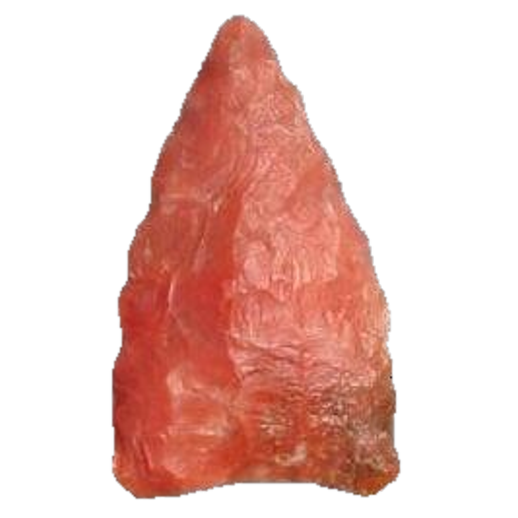
Arrowhead type
Cortaro Point
CortaroCortaro Cluster4,500 - 3,500 B.P.Middle Archaic to Late Archaic2 reference photos
Key facts
- Age
- 4,500 - 3,500 B.P.
- Cultural period
- Middle Archaic to Late Archaic
- Size
- Small to Medium
- Shape
- Triangle to Lanceolate
- Glacial period
- Neoglacial to Roman Warm
More from the Archaic period
Description
This point exhibits a distinctive triangular to lanceolate morphology, characterized by a cross-sectional profile that ranges from elliptical to a pronounced median ridge, often resembling a diamond shape. Its proportions can vary significantly, spanning from slender and symmetrical with a flattened cross section to more robust and asymmetrical with a notable median ridge. The blade itself is excurvate, typically narrowing at the base and achieving its maximum width just above this point. In cases where the point has undergone extensive re-sharpening, it may assume a pentagonal silhouette. The base of the point is concave, with the degree of concavity varying from shallow to deep. A common feature of this point is basal thinning, which suggests a deliberate attempt to reduce weight and enhance balance. The manufacturing technique employed in the production of this point involves percussion flaking, occasionally supplemented by pressure flaking along the edges, resulting in a random, non-patterned flaking arrangement.
Size
The dimensions of the arrowheads are characterized by a total length ranging from 29 to 58 mm, with a mean length typically falling between 40 to 50 mm. The maximum blade width spans 14 to 22 mm, while the basal width measures between 14 to 24 mm, averaging 17 to 21 mm. Additionally, the basal concavity is observed to be between 1 to 4 mm.
Distribution
This projectile is mainly discovered in northern Sonora and extends into southern Arizona, with occasional sightings in southwestern New Mexico. The style was identified at the La Playa location in northern Sonora, Mexico
Additional information
In the realm of Native American archaeology, a particular point of interest has been identified as potentially linked to the Summit Valley Barbed point, a type previously discovered at the Millingstone Horizon Site in Summit Valley, San Bernardo County, California. This connection was initially proposed by researchers Mark Q. Sutton, Joan S. Schneider, and Robert M. Yohi II in their 1993 study. However, further investigation is required to solidify the relationship between these two points, as noted by Justice in 2002. A more in-depth analysis would provide valuable insights into the cultural and historical contexts of these artifacts, ultimately enhancing our understanding of the technological and stylistic developments of Native American arrowheads.
The Summit Valley Barbed point, as a reference, offers a foundation for comparative analysis, allowing researchers to discern similarities and differences between the two points. By examining the morphological characteristics, manufacturing techniques, and distribution patterns of these artifacts, archaeologists can gain a deeper understanding of the cultural exchange networks, migration patterns, and technological innovations that defined the lives of Native American communities. The Millingstone Horizon Site, in particular, has yielded significant information about the prehistoric occupation of the region, with the Summit Valley Barbed point serving as a diagnostic tool for dating and cultural affiliation.
As researchers continue to explore the connection between these points, they must consider the complexities of archaeological interpretation, taking into account the limitations of the current data and the need for additional evidence. The work of Justice in 2002 highlights the importance of rigorous scientific inquiry in establishing a definitive link between the two points. By building upon the foundational research of Sutton, Schneider, and Yohi II, and incorporating new findings and methodologies, archaeologists can refine their understanding of Native American arrowheads, ultimately shedding light on the rich cultural heritage and historical experiences of the indigenous peoples who created these artifacts.
Identified by
- Named by
- Barbara Roth and Bruce B. Huckell
- Year
- 1991
- Type site
- Cortaro Fan Site, Arizona
Similar types
Types that are easy to confuse with the Cortaro point.