
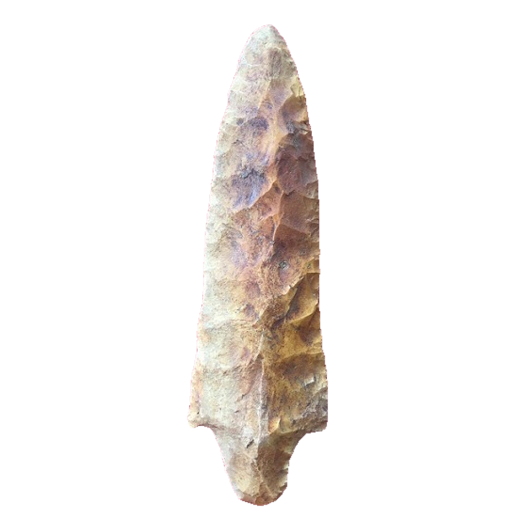
Arrowhead type
Coker Point
CokerEarly Archaic to Middle Archaic7 reference photos
Key facts
- Cultural period
- Early Archaic to Middle Archaic
- Size
- Medium to Large
- Shape
- Contracting Stem to Straight Stem
- Material
- Limestone
- Glacial period
- Culture:
More from the Archaic period
Description
This triangular knife, measuring between 3 to 5.5 inches in length, exhibits a distinctive contracting stem point morphology. Its slender, elliptical cross-section supports a blade with an excurvate profile, where the tip curves inward and the edges converge to near-parallelism. Notably, one edge of the blade tends to be straighter than the opposing edge, contributing to the point's asymmetrical character. The shoulders, primarily horizontal in orientation, display a notable discrepancy in width, with the shoulder adjacent to the excurvate edge being broader and the other shoulder narrower. In some instances, the shoulders may exhibit a subtle, barbed quality. The stem, tapering to a convex base, is a hallmark of this point's design. The overall craftsmanship is often of high quality, as evidenced by the precise, random flaking pattern that covers the point's surface.
Size
The dimensions of the arrowheads are characterized by the following measurements: overall length ranges from 75 to 125 mm, while the stem length spans 15 to 25 mm. The blade width varies between 30 and 50 mm, and the stem width at the shoulder joint measures between 18 and 25 mm. In terms of thickness, the average measurement is 10 mm, although it is essential to note that this value is derived from a limited sample size.
Distribution
The location of this artifact is unclear. It has been discovered in Hillsboro County, Florida, but may share a comparable geographic range to the Thonotosassa point in central Florida
Mainly found in
Additional information
In the realm of archaeological nomenclature, the designation of certain projectile points as "Wills points" is a fascinating example of how local terminology can emerge. This moniker is attributed to the nickname of an individual, Mr. Marvin Masser, which was affectionately bestowed upon him by his acquaintances. As noted by Schroder in 2012, this colloquialism was subsequently adopted by local collectors to refer to these specific types of points, thereby solidifying their place in the regional archaeological lexicon.
The origins of this naming convention underscore the complex and often personal nature of archaeological classification, where local knowledge and oral traditions can significantly influence the development of taxonomic categories. By examining the etymology of terms like "Wills points," researchers can gain a deeper understanding of the social and cultural contexts in which archaeological discoveries are made and interpreted. Furthermore, this example highlights the importance of considering the historical and social factors that shape our understanding of the past, as well as the need for nuanced and contextualized approaches to archaeological classification.
The "Wills points" designation serves as a testament to the dynamic interplay between local collectors, researchers, and the archaeological record. As archaeologists continue to study and refine our knowledge of these points, it is essential to acknowledge the role of local knowledge and terminology in shaping our understanding of the past. By doing so, we can work towards a more comprehensive and inclusive appreciation of the cultural and historical contexts in which these artifacts were created and used.
Identified by
- Named by
- James Gray and Lloyd Schroder
- Year
- 1976
- Type site
- Marvin Masser Farm, Hillsboro County, Florida
Similar types
Types that are easy to confuse with the Coker point.
- Putnam
- Thonotosassa