
Arrowhead type
Citrus Basal Notch Point
Citrus Basal Notch2,00 - 1,600 B.P.Early Woodland to Middle Woodland22 reference photos
Key facts
- Age
- 2,00 - 1,600 B.P.
- Cultural period
- Early Woodland to Middle Woodland
- Size
- Small to Medium
- Shape
- Basal Notch
- Glacial period
- Roman
More from the Woodland period
Description
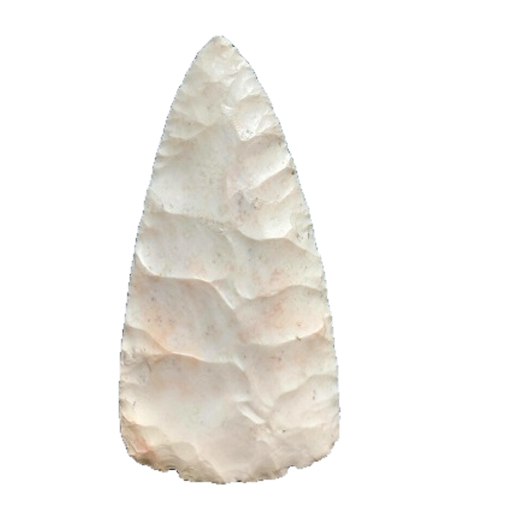
This triangular basal notch point exhibits a slender profile, measuring between 1.75 and 3 inches in length, with a cross-sectional shape that transitions from flattened to a thin elliptical form. The blade's curvature varies, ranging from excurvate to straight, while the barbed shoulders extend downward to the base of the point. Characteristic U-shaped notches, broad and relatively short, are situated at the base, typically with a depth that is approximately one and a half times the notch's width. The stem's outline ranges from straight to slightly expanding, and the base is either straight or mildly convex, with basal corners that can be sharp or slightly rounded. The flaking pattern on this point is random, and overall, the craftsmanship is of high quality, indicating a well-made tool.
Size
The dimensions of the arrowheads are as follows: they range in overall length from 40 to 85 mm, with stem lengths varying between 7 and 11 mm. The width of the blade spans 35 to 50 mm, while the stem width typically falls within the 20 to 25 mm range, although it can extend from 17 to 30 mm.
Distribution
This type is mainly discovered in Florida, extending into southern Georgia and southern Alabama. It has infrequently been spotted in central Georgia and the southwestern region of South Carolina
Mainly found in
Also found, less often, in
Additional information
In the realm of Native American archaeology, the distinction between Citrus and Hernando points has sparked debate among scholars. Some researchers propose that these two point types exist on a continuum, representing variations of a single form, while others argue that they are distinct categories. Notably, both types are often discovered in the same geographic regions and exhibit similar characteristics, frequently co-occurring at the same archaeological sites and stratigraphic levels. This overlap has led some to suggest that the Citrus and Hernando points may be interrelated, with one potentially being a variant of the other.
A closer examination of the morphological characteristics of these points reveals subtle yet significant differences. The Citrus type is distinguished by its wider, larger stem, which features deeper notches compared to the Hernando type, as observed by Granger and Granger (2013). Furthermore, the Citrus point is characterized by a straight to convex base, accompanied by an excurvate blade with rounded edges on the outer barbs, as described by Bullen (1975). In contrast, Hernando points tend to have straighter blades and squarer barbs. Additionally, the Citrus point is generally slightly larger than the Hernando point, leading some researchers to propose that the Citrus point may be a knife form of the Hernando point, as suggested by Bullen (1975).
The primary distinguishing feature between the Hernando and Citrus points, as noted by Bullen (1975), is the presence of a "basally curved tang" or "rocker" base in the Citrus type. This distinctive basal morphology sets the Citrus point apart from its Hernando counterpart, highlighting the complexity and nuance of these archaeological artifacts. By examining the subtle variations between these point types, researchers can gain a deeper understanding of the technological, cultural, and historical contexts in which they were created and used, ultimately shedding light on the lives and traditions of the Native American communities that crafted them.
Identified by
- Named by
- Ripley P. Bullen
- Year
- 1968
Similar types
Types that are easy to confuse with the Citrus Basal Notch point.