
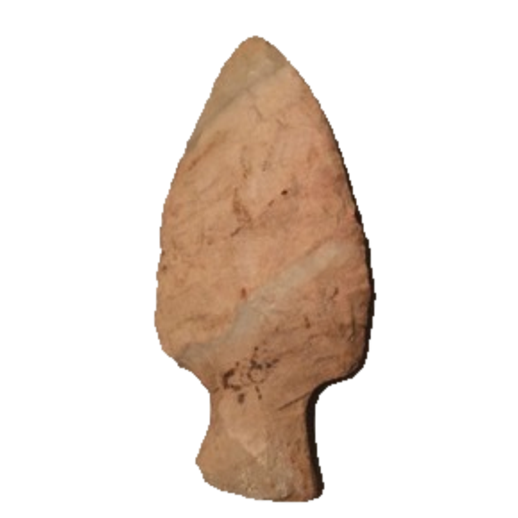
Arrowhead type
Bottleneck Point
BottleneckTable Rock Cluster4,000 - 3,000 B.P.Late Archaic10 reference photos
Key facts
- Age
- 4,000 - 3,000 B.P.
- Cultural period
- Late Archaic
- Size
- Medium
- Shape
- Expanding Stem
- Glacial period
- Neoglacial
More from the Archaic period
Description
This triangular point exhibits a distinctive morphology, characterized by a medium-sized, expanding stem and an elliptical cross-sectional profile. The blade itself is marked by an excurvate shape, accompanied by broad, rounded notches that add to its overall contour. The shoulders of the point typically slope upward, although a subset of specimens may display horizontal shoulders, introducing a degree of variability to this trait. The stem's shape can range from slightly expanding to more pronounced expansion, underscoring the point's adaptability. A convex base with rounded corners at the basal extremities is a consistent feature, often complemented by extensive basal grinding that suggests a high degree of craftsmanship. The flaking pattern observed on this point is random, with fine pressure flaking being a common technique used in its manufacture, highlighting the skill and precision of its creators.
Size
The arrowheads exhibit a range of dimensions, with overall lengths spanning 25 to 75 mm, and averaging between 45 to 50 mm. The stem section measures between 14 to 25 mm in length. In terms of width, the blade ranges from 20 to 30 mm, while the neck width is between 10 to 16 mm. The stem itself has a width of 16 to 22 mm.
Distribution
This type is mainly discovered in the central to northern regions of the Mississippi River basin, extending into the Ohio River basin and the Missouri River basin
Mainly found in
Additional information
In the realm of Native American arrowhead typology, the distinction between the Table Rock and Bottleneck points has been a subject of interest among archaeologists. According to Justice (2002), a key differentiator between the two point types lies in their morphology, with Table Rock points generally exhibiting larger and wider dimensions, albeit with less defined characteristics. Notably, Justice suggests that the Table Rock point may have evolved from the Matanzas point, highlighting the complex and nuanced nature of point typology.
An alternative perspective is offered by Waldorf and Waldorf (1987), who propose that the Table Rock and Bottleneck points may, in fact, be the same point type or, at the very least, the Bottleneck point could be considered a regional variant of the Table Rock point. This notion is further complicated by the observations of the University of Minnesota, which describe the Table Rock point as a larger, thicker specimen, whereas the Bottleneck point is characterized by its smaller size, large round notches, and finer pressure flaking. The distribution patterns of these point types also reveal interesting geographic trends, with the Table Rock point found further west and the Bottleneck point located further east.
A fascinating case study that underscores the complexities of point typology is the Apple Blossom Stemmed points discovered at the Koster Site. Justice (2002) argues that these points were initially misidentified and are, in fact, more accurately classified as Bottleneck type points. This reevaluation suggests that the Table Rock and Bottleneck points may not be discrete categories, but rather represent a continuum of the same point type. This finding highlights the importance of careful analysis and consideration of regional variation in the classification of Native American arrowheads, ultimately contributing to a deeper understanding of the technological and cultural developments of ancient societies.
Identified by
- Named by
- Leon G. Kramer
- Year
- 1947
Similar types
Types that are easy to confuse with the Bottleneck point.