
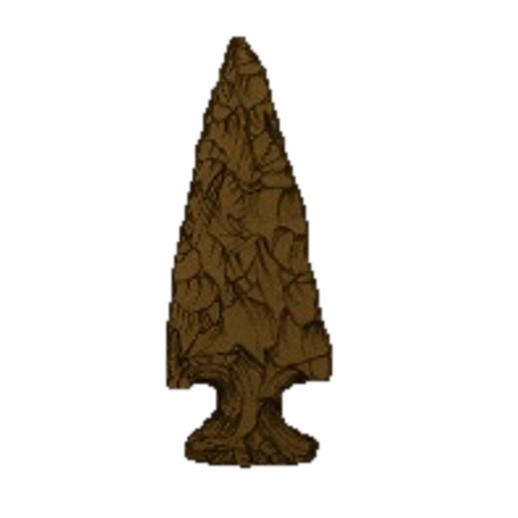
Arrowhead type
Black Mesa Narrow Neck Point
Black Mesa Narrow NeckBlack Mesa Cluster1,900 - 1,200 B.P.Transitional Archaic to Developmental4 reference photos
Key facts
- Age
- 1,900 - 1,200 B.P.
- Cultural period
- Transitional Archaic to Developmental
- Culture
- Basketmaker II
- Size
- Small to Medium
- Shape
- Expanding Stem to Side Notch
- Material
- Obsidian
- Glacial period
- Roman Warm to Vandal Minimum to Warm
More from the Archaic, Developmental periods
Description
This triangular point exhibits a distinctive morphology, characterized by a side notch configuration and a cross-sectional profile that ranges from flattened to elliptical. The blade's curvature varies, spanning from excurvate to straight, and is accentuated by fine, sharp serrations. Notably, the wide, circular U-shaped notches are positioned low on the blade, creating a deep indentation that results in a narrow or fragile neck. The orientation of the notches relative to the base influences the point's overall appearance, yielding either a corner notch or side notch morphology. The shoulders of this point are typically horizontal, although some specimens may display slightly barbed shoulders. The stem expands outward, terminating in a base that is either straight or convex. The manufacturing process involves percussion flaking, which is subsequently refined through fine pressure flaking, yielding a random, intricate flaking pattern that covers the point's surface.
Size
The dimensions of these arrowheads are characterized by the following measurements: overall length ranges from 38 to 68 mm, with a mean length of 42 mm. The stem segment measures between 7 and 11 mm in length, averaging between 9 and 10 mm. The blade's width spans 14 to 26 mm, with an average width of 21 mm. At the neck, the width varies from 4 to 9 mm, with a typical width of 6 mm. Notch depth is observed to be between 3 and 9 mm. The stem's width falls within the range of 12 to 22 mm, while the thickness of the arrowhead is measured to be between 4 and 8 mm.
Distribution
This type is mainly discovered in the southwestern intersection area (notably the Black Mesa locality). These specimens stretch into Concho Arizona and along the Little Colorado River valley
Mainly found in
Additional information
In the realm of Native American arrowhead typology, the Amargosa, Elko, and San Pedro points exhibit a notable similarity in their overall shape and form. However, a distinguishing characteristic that sets them apart from other point types, such as the Black Mesa point, is the absence of a narrow, fragile neck. This distinctive feature is a key diagnostic trait that archaeologists use to differentiate these point types. By examining the morphology of these arrowheads, researchers can gain valuable insights into the technological and cultural practices of the indigenous groups that crafted them.
The Amargosa, Elko, and San Pedro points are significant not only for their shared characteristics but also for their geographic and cultural associations. Each of these point types has been found in specific regions and has been linked to particular Native American groups, providing important information about the migration patterns, trade networks, and cultural exchange that occurred among these communities. For instance, the Amargosa point is typically associated with the southwestern United States, while the Elko point is more commonly found in the Great Basin region. The San Pedro point, on the other hand, has been discovered in the southwestern and southern regions of North America.
The study of these arrowhead types offers a unique window into the lives and traditions of Native American communities, highlighting their resourcefulness, adaptability, and craftsmanship. By analyzing the design and construction of these points, archaeologists can reconstruct the technological and cultural contexts in which they were created, shedding light on the complex and diverse histories of indigenous peoples in North America. Furthermore, the comparison of these point types with others, such as the Black Mesa point, allows researchers to identify patterns and trends that can inform our understanding of the broader cultural and historical landscape of the region.
Identified by
- Named by
- Noel Justice
- Year
- 2002
Similar types
Types that are easy to confuse with the Black Mesa Narrow Neck point.