
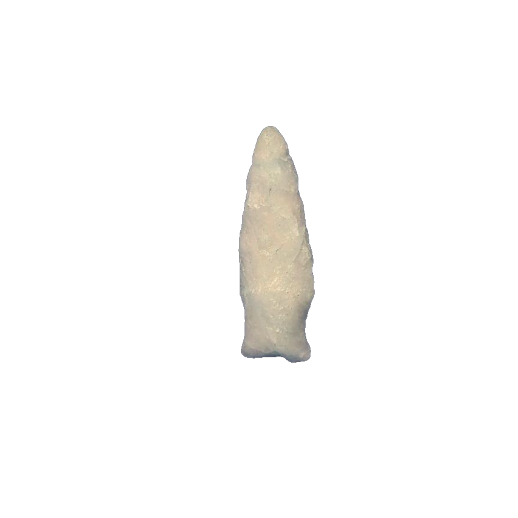
Arrowhead type
Bayou Goula Fishtail Point
Bayou Goula Fishtail800 - 400 B.P.Mississippian23 reference photos
Key facts
- Age
- 800 - 400 B.P.
- Cultural period
- Mississippian
- Culture
- Natchez Culture
- Size
- Small to Medium
- Shape
- Expanding Stem to Auriculate
- Glacial period
- Medieval Warm to Little Ice Age
More from the Mississippian period
Description
This triangular point exhibits a distinctive morphology, characterized by a medium-sized expanding stem and an elliptical profile. The blade's longitudinal axis is predominantly straight, although subtle variations in curvature can occur, ranging from a slight outward convexity to a gentle inward concavity. The presence of wide, parallel notches situated low on the blade gives rise to a pronounced shoulder, angled upward, which transitions into a compact, expanding stem. The basal margin is marked by a concave curvature. The flaking pattern on this point is characterized by a non-directional, random arrangement of flake scars.
Size
The dimensions of the arrowheads are as follows: they typically range in overall length from 28 to 60 mm, with an average length of 35 to 45 mm. The stem measures between 6 to 12 mm in length. The blade width varies from 9 to 20 mm, while the neck width ranges from 5 to 10 mm. The stem width is slightly narrower than that of the blade. In terms of thickness, the arrowheads measure between 3 to 6 mm, with an average thickness of 4 mm.
Distribution
This type is mainly discovered in the southern region of the Mississippi River Valley, spanning Louisiana, and extending into southwestern Mississippi and southeastern Texas
Mainly found in
Additional information
The archaeological classification of a particular point style originated from its initial discovery at the Bayou Goula site, which subsequently lent its name to this distinct type of artifact. Over time, the nomenclature evolved, with the term "Bayou Goula" being condensed into a single word, "Bayougoula point," which has since become the standard reference in the field. Notably, various publications have also adopted an alternative spelling, omitting the "u" to yield "Bayogoula," highlighting the flexibility in terminology that can occur in the documentation of archaeological findings. Despite these minor variations in spelling, the Bayougoula point remains a well-defined and recognizable category within the realm of Native American arrowhead studies.
Identified by
- Named by
- George I Quimby and Clarence Webb
- Year
- 1957
- Type site
- Bayou Goula Site, Iberville Parish, Louisiana
Similar types
Types that are easy to confuse with the Bayou Goula Fishtail point.