
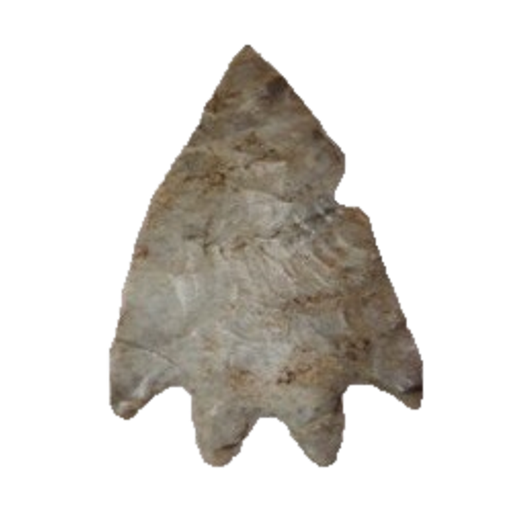
Arrowhead type
Basal Double Tang Point
Basal Double Tang3,500 - 2,000 B.P.Transitional ArchaicKey facts
- Age
- 3,500 - 2,000 B.P.
- Cultural period
- Transitional Archaic
- Size
- Medium to Large
- Shape
- Bifurcated to Straight Stem
- Glacial period
- Neoglacial to Roman Warm
More from the Archaic period
Description
This triangular point features a medium-width stem and an elliptical profile. Initially, the blade exhibits a pronounced excurvate shape, although repeated resharpening can transform it into an incurvate form. The shoulders are distinguished by barbed tips, while the stem remains straight. A notable characteristic of the base is the presence of a deep, central basal notch that spans the entire length of the stem, creating the illusion of dual stems. The flaking pattern on this point is randomized, lacking a discernible order or sequence.
Size
The dimensions of the arrowheads are as follows: they range in overall length from 25 to 55 mm, with stem lengths varying between 5 and 8 mm. The width of the blade spans 28 to 50 mm, while the stem width at the shoulders measures between 23 and 25 mm, based on a limited dataset.
Distribution
This type is mainly discovered in Zacatecas, Mexico and extends into western Texas and southern New Mexico with diminishing occurrence.
Mainly found in
Also found, less often, in
Additional information
More information needed.
Identified by
- Named by
- Richard MacNeish
- Year
- 1958
- Type site
- Pueblo Site, Sierra De Tamaulipas, Mexico
Similar types
Types that are easy to confuse with the Basal Double Tang point.