
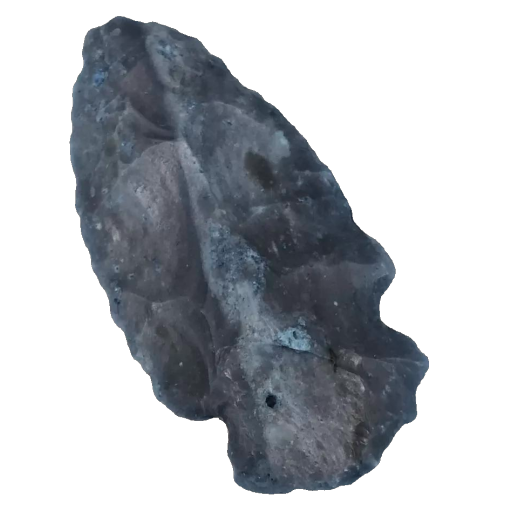
Arrowhead type
Axtel Point
Axtel4,500 - 3,000 B.P.Late Archaic5 reference photos
Key facts
- Age
- 4,500 - 3,000 B.P.
- Cultural period
- Late Archaic
- Size
- Medium
- Shape
- Expanding Stem
- Material
- Limestone
- Glacial period
- Neoglacial
More from the Archaic period
Description
This medium-sized, triangular point features a distinctive elliptical profile and exhibits a stem that broadens towards its base, which is typically convex or rounded in shape. The blade itself can display a range of curvature, from gently excurvate to straight, and is often characterized by fine serrations along its edges, accompanied by a subtle beveling. The shoulders of the point are generally oriented horizontally, although they can occasionally be slightly barbed. A notable feature of this point is its long, rounded stem, which is frequently marked by extensive basal grinding. The flaking pattern observed on this point is random, lacking a consistent or deliberate arrangement of flakes.
Size
The arrowhead's dimensions are as follows: its overall length ranges from 45 to 80 mm, while the stem measures between 13 and 20 mm in length. The blade's width spans 20 to 30 mm, and the neck width varies from 15 to 25 mm. The stem's width, slightly narrower than the blade, falls within the range of 17 to 27 mm.
Distribution
This type is mainly located in the central to eastern regions of Texas.
Mainly found in
Also found, less often, in
Additional information
In the realm of Native American archaeology, a distinct type of arrowhead has been identified, characterized by its rounded stem and notable basal grinding. This particular style of point has been colloquially referred to as "Penny Points" due to the unique morphology of its stem. As observed by Turner and Hester in their 1985 research, the basal area of these points often exhibits heavy grinding, a trait that distinguishes them from other types of arrowheads. This characteristic feature provides valuable insight into the craftsmanship and technological capabilities of the cultures that created these points, highlighting the importance of meticulous stone tool production in the lives of Native American communities.
Identified by
- Named by
- Frank Bryan
- Year
- 1936
- Type site
- Western Limestone County, Texas
Similar types
Types that are easy to confuse with the Axtel point.