
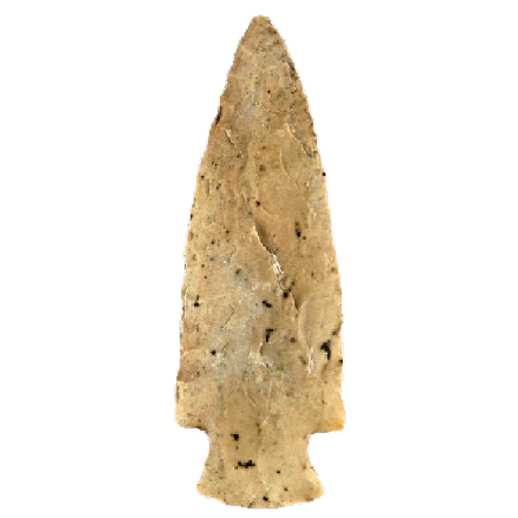
Arrowhead type
Godley Point
Godley2,500 - 1,300 B.P.Late Archaic to Prehistoric9 reference photos
Key facts
- Age
- 2,500 - 1,300 B.P.
- Cultural period
- Late Archaic to Prehistoric
- Size
- Small to Medium
- Shape
- Expanding Stem to Side Notch to Corner Notch
- Glacial period
- Roman Warm to Vandal Minimum
More from the Archaic period
Description
This triangular point exhibits a distinctive morphology, characterized by a small to medium size and an elliptical cross-sectional profile. The blade itself is slender, often maintaining a straight trajectory, although some specimens display a subtle excurvate curvature. In certain instances, the blade narrows to an extreme degree, imparting a spiked appearance to the point. The shoulders are well-defined and typically inclined at an upward angle, forming a pronounced demarcation from the stem. The expanding stem is generally narrower than the shoulders, while the base is smoothly convex and frequently retains nodular cortex remnants. Many examples feature a ground stem, sometimes accompanied by beveling, although this feature is exclusively confined to the stem, as the blade itself remains unbeveled. The flaking pattern on this point is characterized by a random, non-directional arrangement of flakes.
Size
The dimensions of the arrowheads are characterized by the following measurements: overall length ranges from 35 to 80 mm, with a mean length of 46 mm. The stem segment spans 14 to 20 mm in length. The blade's width varies between 15 and 25 mm, averaging 20 mm. Additionally, the neck width is measured between 12 and 17 mm, while the stem's width falls within the range of 14 to 25 mm.
Distribution
This type is mainly located in the central to east-central regions of Texas. It can also be discovered, albeit less often, in southwestern Louisiana and southern parts of Oklahoma
Additional information
In the realm of Native American arrowhead classification, a notable distinction was proposed by Forrester in 1964. This scholar identified two distinct variations within a particular arrowhead type, which he termed the Klondike and Kimball variations. Although Forrester's work provided a foundation for further research, these specific designations failed to gain widespread acceptance or usage within the archaeological community. As a result, the Klondike and Kimball variations, despite being initially recognized, have not become integral to the standard nomenclature used in the field. Nevertheless, Forrester's contribution remains significant, as it highlights the complexity and diversity of Native American arrowhead types, underscoring the need for continued research and refinement in our understanding of these ancient artifacts.
Identified by
- Named by
- Edward B. Jelks
- Year
- 1962
- Type site
- Kyle Site, Hill County, Texas
Similar types
Types that are easy to confuse with the Godley point.