
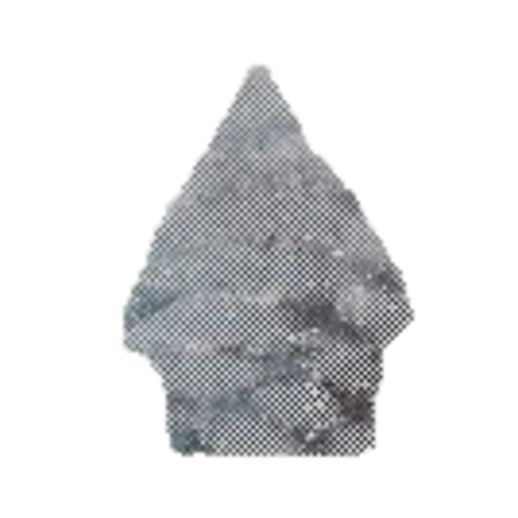
Arrowhead type
Armadillo Point
Armadillo2,000 - 1,500 B.P.Transitional Archaic2 reference photos
Key facts
- Age
- 2,000 - 1,500 B.P.
- Cultural period
- Transitional Archaic
- Size
- Small
- Shape
- Contracting Stem to Straight Stem
- Glacial period
- Roman Warm
More from the Archaic period
Description
This diminutive point, measuring between 1 to 1.5 inches in length, exhibits a triangular form with a contracting stem. Its cross-sectional profile is characterized by a thin, elliptical shape. The blade's longitudinal axis is generally straight, although subtle variations in curvature can occur, ranging from a slight excurvate to a slight incurvate profile. The shoulders are typically well-defined and narrow, but can also be weak or even absent in some instances. The stem is relatively short, with a morphology that varies from slightly contracting to straight, and is accompanied by a base that can be straight or slightly convex. Evidence of basal and hafting region grinding is present, indicating deliberate shaping and preparation for attachment. The point's fabrication involved an initial stage of percussion flaking to rough out the preform, followed by pressure flaking to refine the shape and sharpen the edges, resulting in a random flaking pattern that reflects the sequential application of these techniques.
Size
The dimensions of the arrowheads are as follows: they typically range from 15 to 35 mm in overall length, with a mean length of 28 mm. The stem portion measures between 6 and 14 mm, averaging 9 mm. The blade itself spans 12 to 28 mm in width, with an average width of 16 mm. At the base, the average width is 12 mm, while the average thickness of the arrowhead is 7 mm.
Distribution
These artifacts have been discovered in the Sierra de Tamaulipas range. Their presence beyond this area has not been documented.
Mainly found in
Additional information
In the realm of Native American arrowhead studies, the Armadillo type, characterized by its contracted stem, holds significant importance. This particular classification was coined by renowned archaeologist Richard S. MacNeish, who initially encountered these artifacts at Los Angeles complex sites in Old Mexico. The temporal context of these discoveries spans from approximately 1200 AD to 1780 AD, providing a glimpse into the technological and cultural preferences of the indigenous populations during this period.
Notable for their compact size, Armadillo arrowheads typically measure between 1 and 1.5 inches in length. Their morphology is distinguished by straight to convex blade edges, which would have facilitated effective hunting and combat applications. The stems of these projectiles are short and slightly contracted, while the bases exhibit a straight to slightly convex profile. These characteristics not only underscore the craftsmanship of their creators but also highlight the adaptability and resourcefulness of Native American communities in utilizing available materials for tool production.
The Armadillo type is a testament to the diversity and complexity of pre-Columbian technologies, and its study has been greatly informed by the foundational work of Richard S. MacNeish, as outlined in his 1958 preliminary report. By examining these artifacts within their cultural and historical contexts, researchers can gain a deeper understanding of the lives and traditions of the people who created and utilized them, ultimately enriching our appreciation for the rich cultural heritage of Native American societies.
Identified by
- Named by
- Richard "Scotty" MacNeish
- Year
- 1958
Similar types
Types that are easy to confuse with the Armadillo point.
- Baker
- Diablo Corner Notch
- Fresnal
- La Mina
- Salado
- Santa Cruz
- Zacatecas
- Zavala