
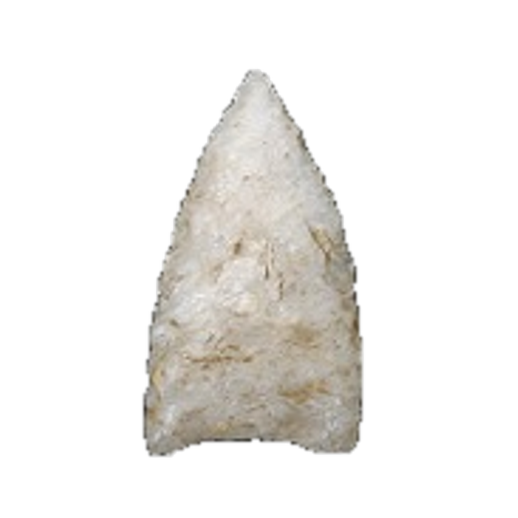
Arrowhead type
Snappit Point
SnappitEastern Archaic Triangle Cluster8,170 - 5,740 B.P.Early Archaic to Middle ArchaicKey facts
- Age
- 8,170 - 5,740 B.P.
- Cultural period
- Early Archaic to Middle Archaic
- Size
- Small to Medium
- Shape
- Triangle to Lanceolate
- Material
- Quartz
- Glacial period
- Middle Holocene
More from the Archaic period
Description
This artifact presents as a compact, triangular point with a symmetrical, isosceles silhouette, characterized by a flattened profile. The blade's curved outline is accentuated by an excurvate shape, accompanied by delicate serrations that impart a finely toothed edge. The basal portion of the point is distinguished by a concave recess, which has been thinned through careful basal thinning, although it lacks fluting. Notably, the craftsmanship evident in this piece is of a high standard, with a flaking pattern that appears random and unstructured, suggesting a deliberate, skilled approach to its manufacture.
Size
The dimensions of these arrowheads are characterized by a total length ranging from 22 to 38 mm and a blade width spanning 16 to 24 mm, as determined from a limited dataset.
Distribution
This type is mainly discovered in the Taunton River Valley and throughout the adjacent area
Additional information
In the realm of Native American arrowheads, a distinct type of point has been identified, characterized by its unique morphology and temporal associations. Unlike the Squibnocket Triangular points, which are typically short and equilateral in shape, these points exhibit a more elongated form. A notable distinction can also be made with Levanna points, which are narrower, have straight sides, and are associated with the Woodland period. In contrast, the points in question are found in Early to Middle Archaic levels, highlighting a significant chronological disparity.
A comparative analysis with other point types reveals further insights into the characteristics of these points. Beekman Triangles, a Middle Archaic type, are generally shorter and more equilateral in shape, whereas these points are thinner and lack basal grinding, similar to Squibnocket Triangle points. The size and shape of these points are comparable to those of Squibnocket Triangles, but their associated points differ, with Squibnocket Triangles often found alongside Squibnocket Stemmed and other Middle Archaic points. In contrast, these points are typically associated with other Early Archaic points, suggesting a distinct cultural and temporal context. Interestingly, Doucette (2005) notes that these points bear similarities to the Early Archaic Un-fluted Triangle points described by Doyel et al. (1985), and may represent an intermediate type between these and the earlier Dalton points.
The excavation at the Boats Site in Dighton, Massachusetts, has provided valuable evidence for the study of these points. According to Grace Bello (2015), a total of 59 points were recovered from this site, with quartz and quartzite being the most commonly used materials. This finding highlights the importance of the Boats Site in understanding the technological and cultural practices of the Native American groups that inhabited this region during the Early to Middle Archaic periods. The recovery of these points, with their distinctive excurvate blades and lack of basal grinding, contributes significantly to our knowledge of the archaeological record, offering a glimpse into the lives and traditions of these ancient cultures.
Identified by
- Named by
- Dianna L. Doucette
- Year
- 1965
- Type site
- Annasnappet Pond Site, Plymouth County, Massachusetts
Similar types
Types that are easy to confuse with the Snappit point.
- Beekman
- Levanna
- Squibnocket Triangle