
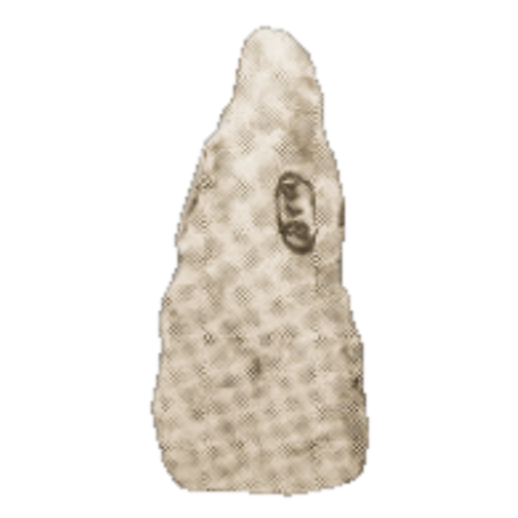
Arrowhead type
Sain Alto Point
Sain AltoLate Southern Triangle Cluster3,000 - 1,050 B.P.Transitional Archaic to Preclassic2 reference photos
Key facts
- Age
- 3,000 - 1,050 B.P.
- Cultural period
- Transitional Archaic to Preclassic
- Culture
- Llano Grande, Loma, Guadiana, and Suchil cultures
- Size
- Medium
- Shape
- Triangle to Ovoid
- Glacial period
- Neoglacial to Medieval Warm
More from the Archaic, Preclassic and Classic periods
Description
The artifact exhibits a triangular morphology with a medium size profile, characterized by an elliptical cross-sectional shape. Its blade profile is slender, displaying a range of forms from straight to subtly excurvate. The basal edge is variable, oscillating between a straight alignment and a gentle convex curvature, with distinct basal corners that are clearly delineated. The flaking pattern observed on this point is random, lacking a discernible or systematic arrangement.
Size
The dimensions of these arrowheads are characterized by a length range of 35 to 56 millimeters, with a mean length of 45 millimeters. The blade width varies between 18 and 33 millimeters, averaging 24 millimeters. In terms of thickness, the measurements span from 3 to 12 millimeters, with an average thickness of 6 millimeters.
Distribution
These artifacts are mainly discovered in Llano Grande, Loma, Guadiana, and Suchil Chalchihuites archaeological zones of Chihuahua, Sonora, Sinloa, Nayarit, Durango, Zacatecas, San Luis Potosi, Jalisco, and Aguascalientes Mexico
Mainly found in
Additional information
In a comparative analysis of Native American arrowhead types, the Suchil Triangular exhibits notable similarities to the Sain Alto Triangular, with the primary distinction being its smaller size (Spence, 1971). This size difference is a key characteristic that sets the Suchil Triangular apart from its larger counterpart. Furthermore, a comparison between the Sain Alto Triangular and the Rio Grande Triangular reveals that while they share similar characteristics, the Rio Grande Triangular tends to have a wider profile, greater mass, and a more pronounced convergence of the blade and base, resulting in a sharper overall shape (Spence, 1971). These subtle yet distinct differences highlight the diversity and complexity of arrowhead designs among Native American cultures.
The similarities and differences between these triangular arrowhead types offer valuable insights into the technological and cultural developments of the regions in which they were found. The Rio Grande Triangular, with its wider and more massive design, may have been adapted for specific hunting or ceremonial purposes, whereas the smaller Suchil Triangular may have been preferred for more precise or delicate tasks. The Sain Alto Triangular, falling between these two types in terms of size and design, may represent a transitional or intermediate form that reflects the dynamic nature of Native American technological and cultural exchange.
The study of these arrowhead types, as documented by Spence in 1971, underscores the importance of meticulous analysis and comparison in understanding the complexities of Native American material culture. By examining the subtle variations in shape, size, and design, researchers can gain a deeper appreciation for the ingenuity, adaptability, and cultural diversity of Native American communities, ultimately enriching our understanding of their history and heritage.
Identified by
- Named by
- Michael W. Spence
- Year
- 1971
Similar types
Types that are easy to confuse with the Sain Alto point.