Named stone
Potomac-region quartzites
Also called Piney Branch quartzite, Rock Creek quartzite, Erwin quartzite, Antietam quartzite, Erwin (Antietam) quartzite
A kind of quartzite
Potomac-region quartzitesQuartziteMid-AtlanticDescription
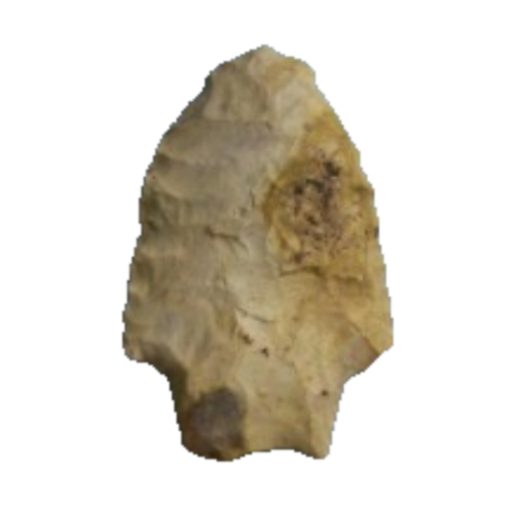
Two quartzite families dominate the Potomac region. Erwin (Antietam) quartzite is a Cambrian beach sandstone, tightly cemented and slightly metamorphosed. It comes in white, tan, brown, pink, red and gray, in fine to medium grain, and is brittle. It forms massive beds on the western slopes of the Blue Ridge in Maryland and Virginia, and it rolls into Great Valley streams as cobbles. Piney Branch quartzite is the cobble stone of Washington, D.C.: the Piney Branch quarries in Rock Creek Park worked large quartzite cobbles from the Potomac Formation gravels, and William Henry Holmes excavated there in 1890. Both stones were used mostly in the Archaic, and Savannah River points are a classic product.
How to identify it
- Colour
- Erwin (Antietam): white, tan, brown, pink, red and grays, light and dark (Virginia DHR). Quartzite in general: gray, white, red and brown (Maryland guide).
- Texture
- Fine to medium grain; finer-grained pieces fracture best. Brittle from intense compaction of the sandstone.
- Inclusions
- The fossil burrow Scolithus occurs in Erwin quartzite in Rockingham and Augusta counties, Virginia; small dark lignite particles can occur in quartzite generally (Maryland guide).
Geology
Erwin (Antietam) quartzite formed in the Cambrian from silica-cemented beach sand that was lightly metamorphosed. Massive beds crop out on the western slopes of the Blue Ridge in Maryland and Virginia; large blocks lie across the ridge sides and cobbles collect in streams of the Great Valley. There are no outcrops on the eastern Blue Ridge slopes, so Piedmont pieces likely arrived as ready-made blanks. Piney Branch quartzite comes from large cobbles in the sand and gravel facies of the Potomac (Patuxent) Formation, and the NPS notes that some artifacts near Barney Circle and the Whitehurst Freeway were made of metaquartzite from the Cambrian Weverton and Gun Hill formations west of Rock Creek Park.
Where it comes from
Mid-Atlantic
Quarries and outcrops
- Piney Branch quarries, Rock Creek Park, Washington, D.C.
- Western Blue Ridge slopes, Maryland and Virginia (massive Erwin/Antietam beds)
- South Fork Shenandoah River, Virginia (Late Archaic campsites with cobble extraction and broadspear manufacture)
- Great Valley stream cobbles
Used by
- Piney Branch cobbles were commonly made into Savannah River points, about 2,500 to 1,500 B.C. (NPS Rock Creek Park)
- Erwin/Antietam: peak use in the Middle to Late Archaic, the Morrow Mountain, Guilford and Savannah River phases (Virginia DHR)
- Piney Branch was excavated in 1890 by William Henry Holmes, which helped end the debate over an American Palaeolithic (Runnels)
Look-alikes
Stones that are easy to confuse with Potomac-region quartzites.
- Ridgely quartzite of western Maryland (white to pink, sugary)
- Other Mid-Atlantic quartzites listed in the Maryland guide: Hardyston, Magothy and Cohansey quartzites
- Vein quartz, which also occurs as cobbles
Sources
- Moldenhauer, Nash and Tolley (1999); updated by Egloff (2008). Erwin (Antietam) Quartzite. Virginia Department of Historic Resources, Lithics (Projectile Points and Lithics guide).dhr.virginia.gov (opens in a new tab)
- National Park Service. 2009. Rock Creek Park: Geologic Resources Inventory Report. Natural Resource Report NPS/NRPC/GRD/NRR--2009/146.npshistory.com (opens in a new tab)
- Runnels, Curtis N. 2020. The Piney Branch site (District of Columbia, U.S.A.) and the significance of the quarry-refuse model for the interpretation of lithics sites. Journal of Lithic Studies 7(1). doi:10.2218/jls.2986.journals.ed.ac.uk (opens in a new tab)
- Maryland Archaeological Conservation Laboratory. Quartzite. Diagnostic Artifacts in Maryland: Common Stone Types (Jefferson Patterson Park and Museum).apps.jefpat.maryland.gov (opens in a new tab)