Named stone
Plateau fine-grained volcanic rock
Also called Columbia Plateau basalt tools (usually andesite or dacite), FGV (fine-grained volcanic), Columbia River Basalt Group toolstone
A kind of basalt and other fine-grained volcanic rock
Plateau fine-grained volcanic rockBasalt and other fine-grained volcanic rockWest Coast & PlateauDescription
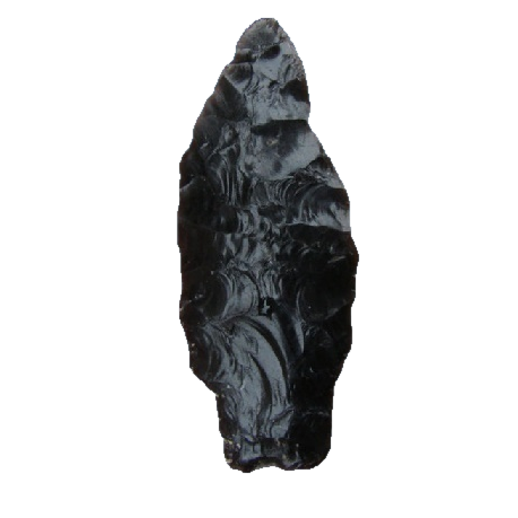
Dark gray fine-grained volcanic rock, often loosely called basalt, is a common toolstone on the Columbia Plateau. Terry Ozbun points out that most artifacts casually called basalt are really andesite, dacite or similar fine-grained, silica-rich rocks, because true basalt has too little silica to flake well. By silica content the series runs from basalt (under 52 percent) through andesite and dacite to rhyolite. The finer-grained, more silica-rich rocks fracture better and give sharper edges, and they hold an edge better than obsidian in rough use. In southeastern Washington, west-central Idaho and northeastern Oregon, workshops in Miocene Columbia River Basalt flows such as Pataha Canyon in the Blue Mountains provided basaltic andesite for large bifacial blanks.
How to identify it
- Colour
- Dark gray (Ozbun).
- Texture
- Aphanitic (crystals too small to see) to porphyritic; fine-grained, more silica-rich rocks flake better and give sharper edges (Ozbun).
Geology
Extrusive volcanic rocks, most of the Plateau stone coming from Miocene flows of the Columbia River Basalt Group. Low-silica basaltic andesites of the Grande Ronde Basalt can be separated chemically from high-silica andesites and dacites of the Saddle Mountain Basalt. Tough, dark rock outcrops as nodular clasts or tabular boulders at workshops.
Where it comes from
West Coast & Plateau
States
Quarries and outcrops
- Pataha Canyon workshop (45UM110), Blue Mountains, southeastern Washington
- Tri-State Uplands: southeastern Washington, west-central Idaho, northeastern Oregon
- Midvale Hill, Washington County, Idaho (blue-gray basalt cobbles, per Moore)
Used by
- Plateau Basal Notch and Windust point types (Library texts, per the plan; the opened chapters do not tie either type to this rock)
- Biface blank production at Pataha Canyon (period not given in the part read)
Look-alikes
Stones that are easy to confuse with Plateau fine-grained volcanic rock.
- Obsidian (glassier; breaks sharper but is more brittle)
- Plateau cryptocrystalline silicates
Sources
- Ozbun, Terry L., and Ron L. Adams, eds. 2015. Toolstone Geography of the Pacific Northwest. Archaeology Press, Simon Fraser University. Chapter 1: Ozbun, Terry L. Toolstone Geography and the Larger Lithic Landscape.archpress.lib.sfu.ca (opens in a new tab)
- Ozbun, Terry L., and Ron L. Adams, eds. 2015. Toolstone Geography of the Pacific Northwest. Archaeology Press, Simon Fraser University. Chapter 9: Reid, Kenneth C., Matthew J. Root, and Daryl E. Ferguson. Estimating Biface Production Output at a Basaltic Andesite Workshop in the Blue Mountains.archpress.lib.sfu.ca (opens in a new tab)