Named stone
Mill Creek chert
Also called Mill Creek flint, Mill Creek hoe chert
A kind of chert (and flint)
Mill Creek chertChert (and flint)Midwest/Ohio ValleyDescription
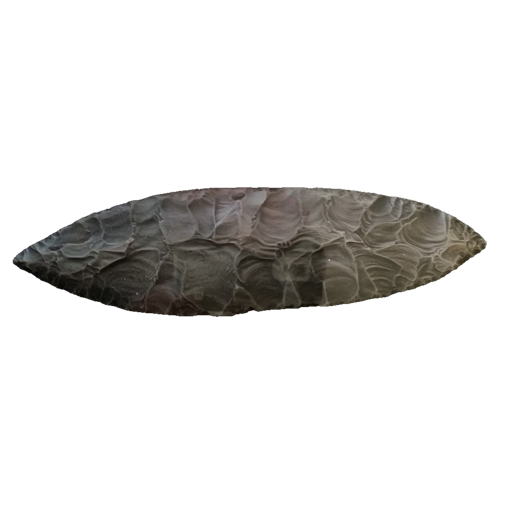
Mill Creek chert is the tough, coarse-grained, brown or gray chert of Union and Alexander counties in southern Illinois, and it is the best-known stone for Mississippian hoes. It occurs in large, flat, elliptical nodules in creek beds and hilltop soil, probably from the Ullin limestone. Colour ranges from white and gray through brown, yellow and reddish-brown to pale blue or black, often with banding that follows the outline of the nodule. The texture is grainy and rough, but a big nodule needs little trimming to become a large biface, and it survives hard use. Mill Creek bifaces were made near the quarries and traded widely across the central Mississippi and Ohio valleys between A.D. 900 and 1400.
How to identify it
- Colour
- White, grayish-white, gray, grayish-brown, yellow, grayish-orange, reddish-brown, orangish-white, pale blue or black (Billings 1984, cited by Barry); the Illinois State Museum calls it brown or gray.
- Texture
- Very coarse, grainy and rough, especially when fossiliferous (Barry).
- Inclusions
- Concentric banding parallel to the nodule surface; fossils in some pieces.
Geology
Nodules probably come from the Ullin Limestone formation of the Mississippian. They occur as large, flat, elliptical nodules in creek beds or hilltop residuum in Union and Alexander counties, Illinois. The nodules are thick and lenticular, so only light edge trimming and cortex removal turns them into large preforms or bifaces, and the stone is physically durable (Cobb 2000, cited by Barry).
Where it comes from
Midwest/Ohio Valley
States
Quarries and outcrops
- Mill Creek area, Union and Alexander counties, southern Illinois
- Quarry and workshop villages near Mill Creek, where bifaces were produced
Used by
- Mississippian: hoes and large bifaces traded A.D. 900-1400 across the central Mississippi and Ohio valleys (Illinois State Museum)
- Found at (not a source): American Bottom villages, where broken hoes and resharpening flakes litter the ground
Sources
- Illinois State Museum. Hand tools: Native American (Mill Creek chert hoe and shell hoe), Agriculture exhibit.museum.state.il.us (opens in a new tab)
- Barry, Steven Edward. 2004. Lithic Raw Materials and Chipped Stone Tools: A Comparison of Two Sites in the Moundville Chiefdom. M.A. thesis, University of Alabama.rla.unc.edu (opens in a new tab)
- Martens, Richard E. 2017. The Common Field Mississippian Site (23SG100). Missouri Archaeological Society Quarterly 34(4).missouriarchaeologicalsociety.org (opens in a new tab)