
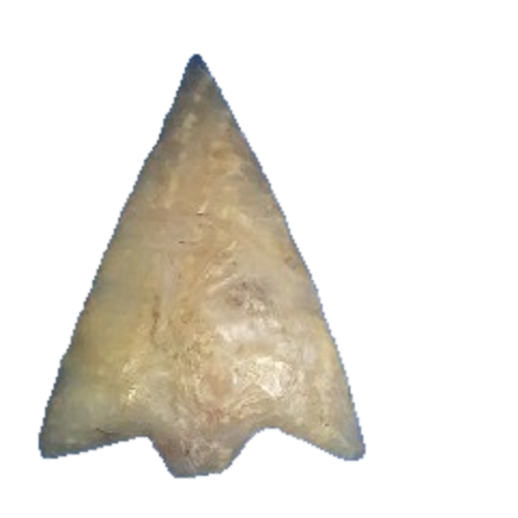
Arrowhead type
Hillsborough Contracting Stem Point
Hillsborough Contracting StemNewnan Cluster5,400 - 3,000 B.P.Middle Archaic to Late Archaic21 reference photos
Key facts
- Age
- 5,400 - 3,000 B.P.
- Cultural period
- Middle Archaic to Late Archaic
- Size
- Medium to Large
- Shape
- Contracting Stem
- Glacial period
- Middle Holocene to Neoglacial
More from the Archaic period
Description
This triangular point exhibits a slender profile, measuring between 1.25 and 4.25 inches in length. Its cross-sectional shape is characterized by a flattened, thin elliptical form. The blade's curvature can range from straight to excurvate, while the shoulders typically slope downward, sometimes extending below the base of the point. The stem is narrow and tapering, with a base that is often convex or pointed, although occasionally it may be straight. The flaking pattern on this point is random, yet it consistently displays a high level of craftsmanship, suggesting a skilled manufacturer. The overall morphology of this point is marked by a contracting stem and a varied blade shape, indicating a deliberate and precise flaking technique.
Size
The dimensions of the arrowheads are characterized by the following measurements: overall length ranges from 38 to 110 mm, with a mean length of 64 mm. The stem, which is the narrower portion, measures between 5 to 10 mm in length. In terms of width, the arrowheads vary from 28 to 55 mm, with an average width of 37 mm. The width of the stem specifically falls within the range of 10 to 15 mm. The thickness of the arrowheads is between 4 to 8 mm.
Distribution
This type is mainly located in the central to northern regions of Florida. It can also be discovered in southern parts of Georgia and southeastern areas of Alabama, albeit less commonly.
Additional information
In the realm of Native American arrowhead typology, the Newnan and Hillsborough points have been subject to extensive study and debate. A consensus among researchers, building upon the foundational work of Bullen, suggests that these two point types are, in fact, variants of a single category (Farr, 2006). A key distinguishing feature between the two lies in the morphology of their stems, with the Hillsborough type exhibiting a narrower and smaller stem in comparison to the wider stem characteristic of the Newnan type (Granger and Granger, 2013). This distinction was first highlighted by Bullen in 1975, who noted that the Newnan point is marked by a more squarish stem, a trait not as pronounced in the Hillsborough point. Although Bullen considered the Hillsborough point as a potential extreme variant of the Newnan, the difference in stem shape remains a significant criterion for differentiation between the two types. Interestingly, local collectors have also referred to a point with similar characteristics as the "Batwing" point, underscoring the complexity and nuance in the classification and naming of these archaeological artifacts.
The nuances in stem morphology between the Newnan and Hillsborough points not only reflect variations in manufacturing techniques and stylistic preferences among prehistoric groups but also highlight the challenges inherent in typological classifications. The fact that these points can be seen as part of a continuum, with the Hillsborough representing a possible extreme end of the Newnan type, speaks to the dynamic and evolving nature of tool production in Native American cultures. The work of Farr (2006) and Granger and Granger (2013) further solidifies our understanding of these point types, emphasizing the importance of detailed morphometric analysis in distinguishing between subtly different archaeological artifacts.
The study of the Newnan and Hillsborough points, including their variants and local designations like the "Batwing" point, contributes significantly to our broader understanding of the technological, social, and cultural contexts of Native American societies. By examining the specific characteristics of these arrowheads, such as stem shape and size, researchers can infer information about the mobility patterns, trade networks, and technological innovations of the groups that produced them. This level of analysis not only enriches our knowledge of prehistoric cultures but also underscores the value of meticulous archaeological research in reconstructing the past.
Identified by
- Year
- 1968
- Type site
- Culbreath Bayou Site, Hillsborough County, Florida
Similar types
Types that are easy to confuse with the Hillsborough Contracting Stem point.