
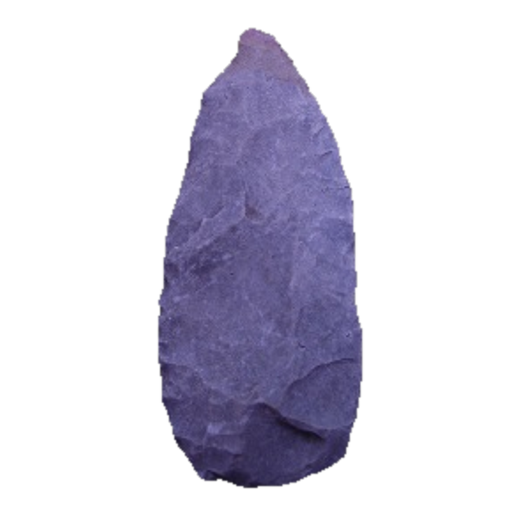
Arrowhead type
Hare Bi-Face Point
Hare Bi-FaceLate Archaic3 reference photos
Key facts
- Cultural period
- Late Archaic
- Culture
- Caddoan Culture
- Size
- Medium to Large
- Shape
- Ovoid
- Glacial period
- Roman Warm to Vandal Minimum
More from the Archaic period
Description
This bi-face exhibits a medium to large ovoid form, characterized by an elliptical cross-sectional profile. Its blade displays an excurvate morphology, marked by an inward curvature at the distal tip and a corresponding curvature at the proximal base. The base itself presents a subtly convex shape, accompanied by evidence of basal thinning. The flaking pattern observed on this specimen is random, lacking a discernible order or organization.
Size
The dimensions of the arrowheads are characterized by a total length ranging from 55 to 95 mm and a width spanning 25 to 45 mm, as determined from a limited dataset.
Distribution
This type is mainly located in the heart of Texas.
Mainly found in
Additional information
In the realm of Native American archaeology, a distinctive type of bi-face artifact has been identified and categorized by various researchers. Notably, Shafer, Suhm, and Scurlock (1964) referred to this particular bi-face as a "Parallel Edge Knife" during their excavations at the Belton Reservoir site. Similarly, Bond (1978) classified a comparable artifact as a "Category 4D Thinned Bi-face Preform" at the Hoxie Bridge Site, a finding later referenced by Turner and Hester (1985). These classifications underscore the significance of this bi-face type, highlighting its unique characteristics and the efforts of archaeologists to understand its role and function within Native American cultures.
The Parallel Edge Knife, or Category 4D Thinned Bi-face Preform, exhibits a specific set of attributes that distinguish it from other bi-face artifacts. Its parallel edges and thinned profile suggest a high degree of craftsmanship and a specific purpose, potentially related to cutting or slicing tasks. The fact that this artifact type has been identified at multiple sites, including Belton Reservoir and the Hoxie Bridge Site, implies a certain level of cultural exchange or technological diffusion among Native American groups. Further study of this bi-face type can provide valuable insights into the lives and traditions of these communities, shedding light on their tool-making techniques, hunting practices, and social interactions.
The classification of this bi-face artifact by Shafer, Suhm, and Scurlock (1964) and Bond (1978) demonstrates the importance of systematic typology in archaeology. By establishing a common vocabulary and framework for describing and analyzing artifacts, researchers can compare and contrast findings from different sites and regions, ultimately contributing to a more comprehensive understanding of Native American cultures and their technological developments. As archaeologists continue to investigate the characteristics and distribution of the Parallel Edge Knife, they may uncover new evidence that refines our understanding of this artifact type and its significance within the broader context of Native American archaeology.
Identified by
- Named by
- Elton Prewitt
- Year
- 1981
- Type site
- Tombstone Bluff Site, Granger Lake District, Texas
Similar types
Types that are easy to confuse with the Hare Bi-Face point.
- Abasolo
- Cleburne
- Covington
- Friday
- Kinney
- Pandora
- San Gabriel