
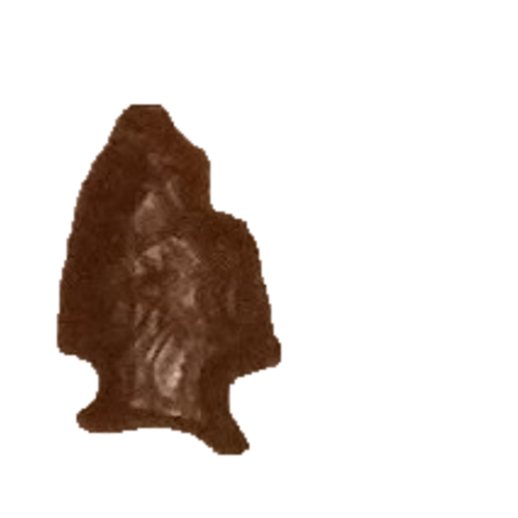
Arrowhead type
Glendo Point
Glendo1,800 - 800 B.P.Classic to Late Prehistory14 reference photos
Key facts
- Age
- 1,800 - 800 B.P.
- Cultural period
- Classic to Late Prehistory
- Size
- Small to Medium
- Shape
- Corner Notch
- Glacial period
- Roman to Medieval Warm
More from the Late Prehistoric, Preclassic and Classic periods
Description
This triangular corner notch point exhibits a compact to moderate size profile, characterized by a cross-sectional shape that oscillates between elliptical and thinly elliptical. The blade's curvature is predominantly excurvate, although re-sharpening can sometimes yield a straighter edge. The shoulders display a range of orientations, from horizontal to subtly barbed, accompanied by a stem that expands outward. The basal contour can vary, spanning from concave to mildly convex. The flaking pattern on this point appears to be random, lacking a discernible order or sequence.
Size
The arrowheads exhibit a range of dimensions, with overall lengths spanning 18 to 40 mm. The stem section measures between 4 and 7 mm in length. In terms of width, the blade ranges from 13 to 21 mm, while the neck width varies from 7 to 11 mm. Additionally, the stem width is recorded as falling within the 11 to 19 mm range.
Distribution
This type is mainly discovered in eastern Colorado and extends into the adjacent Prairie areas
Mainly found in
Also found, less often, in
Additional information
In the realm of Native American archaeology, the study of arrowheads has led to a nuanced understanding of the distinction between dart and arrow forms. Notably, the dart form tends to be slightly larger in size compared to its arrow counterpart. However, the disparity between these two forms can be subtle, often requiring a closer examination to discern the differences. To address this challenge, researchers Hildebrandt and King (2012) introduced a novel approach to differentiate between darts and arrows. By calculating the sum of the neck width and maximum thickness, they established a metric known as the Dart-Arrow Index. This index provides a clear criterion for classification: if the result exceeds 11.8 mm, the artifact is categorized as a dart, whereas a value below 11.8 mm indicates an arrow. This formula offers a valuable tool for archaeologists to accurately identify and distinguish between these two forms, ultimately enhancing our understanding of the technological and cultural developments of Native American communities.
Identified by
- Named by
- Louis Steege
- Year
- 1961
- Type site
- Glendo Reservoir Site, Wyoming
Similar types
Types that are easy to confuse with the Glendo point.
- Avonlea
- Besant
- Pelican Lake
- Samantha