
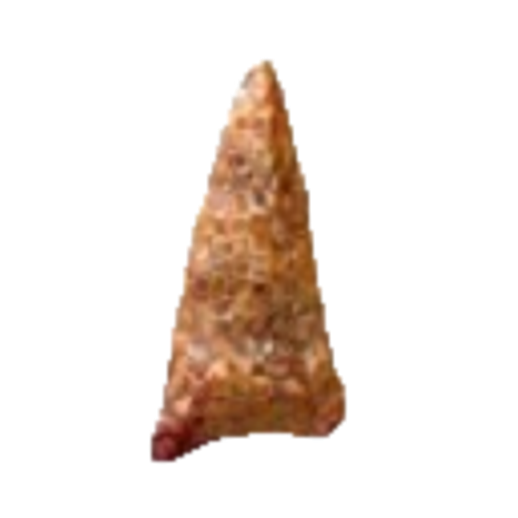
Arrowhead type
Garden Creek Point
Garden CreekLate Woodland Triangle Cluster to Early Mississippian Triangle Cluster2,200 - 1,800 B.P.Middle WoodlandKey facts
- Age
- 2,200 - 1,800 B.P.
- Cultural period
- Middle Woodland
- Size
- Small
- Shape
- Triangle to Lanceolate
- Material
- Slate
- Glacial period
- Roman Warm
More from the Woodland period
Description
This artifact exhibits a distinctive isosceles triangular form, measuring between 1.25 and 2.67 inches in length, with a characteristic length-to-width ratio of approximately 3:1. Its cross-sectional profile is elliptical, lending a sleek appearance to the overall shape. The blade itself is notably elongated and slender, featuring a straight edge that may exhibit subtle variations, ranging from a slight excurvate to a slight incurvate curvature. The base of the point displays a range of concavity, from slightly concave to more pronounced. Notably, both the tip and basal corners tend to be sharply defined. The flaking pattern observed on this point is random, indicating a lack of deliberate, patterned removals. In terms of manufacture, this point was produced using direct percussion flaking, with subsequent fine-tuning achieved through pressure flaking along the edges, resulting in a refined finish.
Size
The dimensions of the arrowheads are characterized by a length range of 31 to 68 mm, with a mean length of 48 mm. The width varies between 21 and 29 mm, averaging 23 mm. In terms of thickness, the measurements fall within a range of 5 to 10 mm. Additionally, the basal concavity is measured at 3 to 6 mm, with an average depth of 4 mm, as reported by Keel in 1987.
Distribution
This type is mainly located in North Carolina and extends into Virginia.
Mainly found in
Additional information
In a notable observation, Keel (1987) draws a comparison between a specific type of arrowhead and the Connestee Triangle, highlighting that the former is distinguishable primarily by its larger size. This insight is significant, as it underscores the potential for misclassification of individual points of this type, which may be mistakenly identified as either Camp Creek or Greenville points. By recognizing these subtle distinctions, researchers can refine their understanding of the diverse array of arrowhead styles and their corresponding cultural associations. Keel's work serves as a valuable reminder of the importance of meticulous classification and the need for ongoing refinement in the field of archaeology, particularly when examining the nuances of prehistoric toolmaking traditions.
Identified by
- Named by
- Bennie C. Keel
- Year
- 1976
- Type site
- The Garden Creek Mound, North Carolina
Similar types
Types that are easy to confuse with the Garden Creek point.
Other types in the Late Woodland Triangle Cluster to Early Mississippian Triangle Cluster
- Pigeon Side Notch