
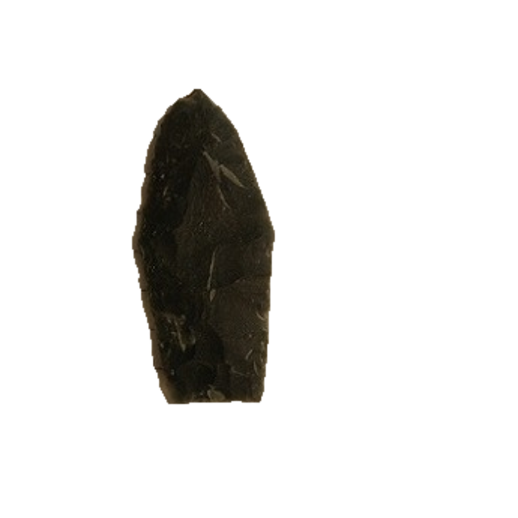
Arrowhead type
Ely's Ford Pentagonal Point
Ely's Ford Pentagonal9,500 - 8,500 B.P.Transitional Paleo to Early Archaic4 reference photos
Key facts
- Age
- 9,500 - 8,500 B.P.
- Cultural period
- Transitional Paleo to Early Archaic
- Size
- Medium
- Shape
- Lanceolate to Triangle to Contracting Stem
- Glacial period
- Early Holocene
Description
This pentagonal point exhibits a slender profile, characterized by a medium thickness and a cross-sectional shape that transitions from elliptical to flattened. The blade's longitudinal axis remains straight from the apex to the hafting area, where it subtly converges towards the base, imparting a pentagonal silhouette. The basal edge varies in morphology, ranging from a straight alignment to a gentle concavity. Notably, some specimens of this point type display fluting. The flaking pattern observed on this artifact is random, lacking a discernible order or orientation.
Size
Medium
Distribution
This type is mainly discovered in the eastern part of Virginia and extending into northeast North Carolina.
Mainly found in
Also found, less often, in
Additional information
In the realm of Native American archaeology, a specific type of arrowhead is frequently misidentified as either a Woodland point, Jack's Reef Pentagonal, or Pee Dee. However, this distinct point is actually an older variant, as evidenced by its discovery in the Paleo-era strata at the Cactus Hill site. One of the most striking features of this point is its slender, pentagonal shape, which sets it apart from other types of arrowheads. This unique morphology is a key characteristic that allows archaeologists to accurately identify and classify this particular point.
The presence of this point in the Paleo strata at Cactus Hill is significant, as it provides valuable insights into the technological and cultural developments of the region's early inhabitants. The fact that this point is an older type suggests that it may have been used by some of the earliest human populations in the area, potentially dating back to the Paleoindian period. Further study of this point and its associated cultural context can shed light on the lives and traditions of these ancient peoples, as well as the evolution of their tool-making technologies.
The pentagonal shape of this point is particularly noteworthy, as it demonstrates a high degree of craftsmanship and attention to detail. The thin, angular shape would have required careful flintknapping techniques to produce, highlighting the skill and expertise of the point's creator. As archaeologists continue to study this point and its counterparts, they can gain a deeper understanding of the cultural and technological exchanges that occurred between different Native American groups, as well as the ways in which their tool-making traditions evolved over time.
Identified by
- Named by
- David Bushnell Jr.
- Year
- 1935
Similar types
Types that are easy to confuse with the Ely's Ford Pentagonal point.