
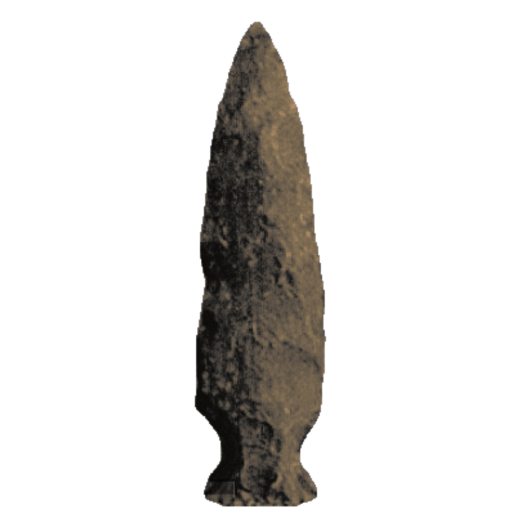
Arrowhead type
Departure Bay Point
Departure Bay2,400 - 1,600 B.P.Late Archaic to Transitional Archaic3 reference photos
Key facts
- Age
- 2,400 - 1,600 B.P.
- Cultural period
- Late Archaic to Transitional Archaic
- Size
- Medium to Large
- Shape
- Expanding Stem to Side Notch
- Glacial period
- Roman Warm
More from the Archaic period
Description
This triangular point exhibits a distinctive morphology, characterized by a medium to large size and an expanding stem that transitions to a side-notched configuration. Its cross-sectional profile is elliptical, providing a sturdy foundation for the excurvate blade, which features shoulders that slope upward at varying angles, ranging from horizontal to moderately angled. The stem itself expands toward the base, which can be either straight or subtly convex. The flaking pattern observed on this point is random, lacking a discernible order or sequence.
Size
The dimensions of these arrowheads are characterized by a length range of 27 to 74 mm, with a mean length typically falling between 43 and 63 mm. In terms of blade width, the measurements span from 21 to 31 mm, with an average width generally ranging from 22 to 26 mm.
Distribution
This specimen was documented at Departure Bay and extensively across the region in the Puget Sound of British Columbia and Washington
Mainly found in
Additional information
In a notable observation, Carlson (2011) suggests that a particular type of artifact may signify a transitional phase in the evolution of projectile points, specifically representing the most recent forms of Atlatl points prior to their conversion into arrow points. A distinctive characteristic of these side-notched arrow points is their relatively crude and thick construction, which differentiates them from their more refined and slender successors. This distinction is significant, as it implies a developmental trajectory in the design and manufacture of arrow points, with earlier forms exhibiting a more rudimentary craftsmanship.
The side-notched arrow points in question are marked by a coarser texture and increased thickness, which sets them apart from the more sophisticated arrow points that followed. This variation in morphology may indicate a period of experimentation and refinement, as ancient craftsmen adapted their techniques to create more efficient and effective hunting tools. The fact that these points are associated with the Atlatl, a spear-throwing device, underscores the significance of this transitional phase, as it highlights the gradual shift towards the use of bows and arrows in hunting and warfare.
The observation by Carlson (2011) underscores the importance of careful analysis and contextualization in understanding the development of Native American projectile points. By examining the morphological characteristics and technological advancements of these artifacts, researchers can gain valuable insights into the cultural, social, and economic dynamics of ancient societies, as well as the innovative strategies they employed to adapt to their environments and respond to changing circumstances. Ultimately, the study of these side-notched arrow points offers a fascinating glimpse into the complex and nuanced history of Native American technologies, and the ways in which they reflect the ingenuity and resourcefulness of their creators.
Identified by
- Named by
- Roy Carlson
- Year
- 2011
- Type site
- Departure Bay, British Columbia
Similar types
Types that are easy to confuse with the Departure Bay point.
- Aishihik
- Calderwood
- Lockhart River