
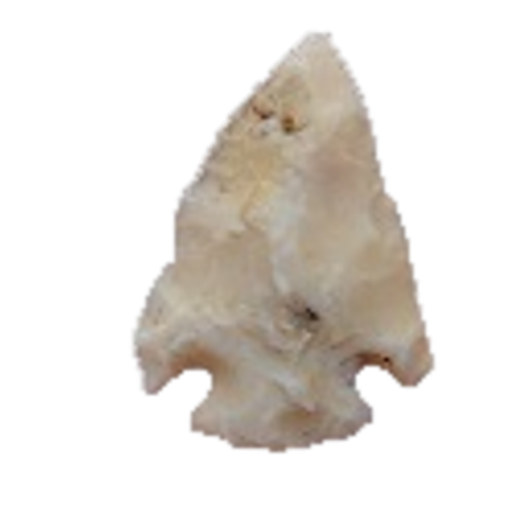
Arrowhead type
Deadman Point
Deadman1,600 - 700 B.P.Developmental to Late PrehistoricKey facts
- Age
- 1,600 - 700 B.P.
- Cultural period
- Developmental to Late Prehistoric
- Culture
- Mogollon Culture
- Size
- Medium to Large
- Shape
- Contracting Stem
- Glacial period
- Roman to Medieval Warm
More from the Late Prehistoric, Developmental periods
Description
This triangular point exhibits a distinctive morphology, characterized by a broad, excurvate blade and a stem that tapers from a convex base. The cross-sectional profile is flattened, transitioning to an elliptical shape. Notable are the deep, invasive notches that originate from the point's corners, extending into the blade and forming pronounced shoulder barbs that commence approximately one-third of the way along the point's length. The stem's shape is marked by a subtle to pronounced expansion, often accompanied by a bulbous swelling. The flaking pattern observed on this point is random, lacking a discernible order or orientation.
Size
The arrowhead's dimensions are as follows: its overall length ranges from 18 to 30 mm, while the stem measures between 5 to 8 mm in length. The blade itself spans a width of 15 to 20 mm, and the maximum width of the stem is also within the 5 to 8 mm range.
Distribution
This projectile is mainly discovered in New Mexico and stretches into Arizona within the territories associated with the Mogollon people. Its range expands into the panhandle and Llano Estacado areas of Texas. This projectile is seldom encountered in the Eastern Trans-Pecos and Big Bend areas
Mainly found in
Additional information
More information needed.
Identified by
- Named by
- Jack T. Hughes and Patrick S. Willey
- Year
- 1978
- Type site
- Deadman's Shelter (41GR256), Swisher County, Texas
Similar types
Types that are easy to confuse with the Deadman point.