
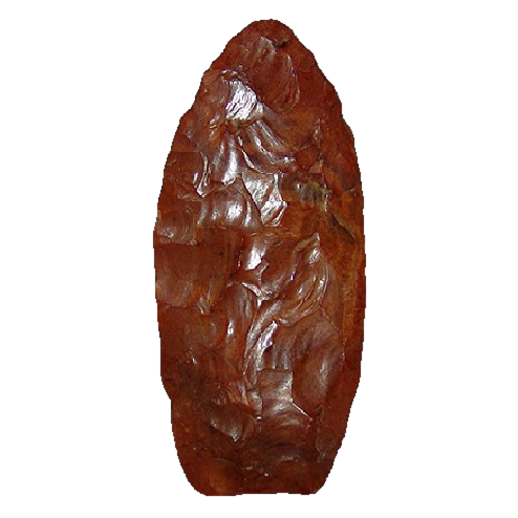
Arrowhead type
Cowhouse Slough Bi-Face Point
Cowhouse Slough Bi-Face10,000 - 8,000 B.P.Transitional Paleo6 reference photos
Key facts
- Age
- 10,000 - 8,000 B.P.
- Cultural period
- Transitional Paleo
- Size
- Medium to Large
- Shape
- Ovoid to Lanceolate
- Glacial period
- Early Holocene
More from the Paleo period
Description
This ovoid point measures between 3 to 5 inches in length, exhibiting a cross-sectional profile that ranges from elliptical to flattened, occasionally presenting a plano-convex shape with one face being more flattened than the other. The blade's curvature is characterized by an excurvate shape, where the edges curve inward toward the tip and then back toward the base. The basal edge is typically slightly concave, although it can vary to a straight configuration. The point is meticulously finished, sometimes featuring fluting, and often displays a pronounced thinning on one face, while the opposing face is subtly beveled with an absence of edge smoothing at the base. The flaking pattern is notable for its broad, random arrangement, complemented by fine pressure flaking that delineates the edges, underscoring the point's refined craftsmanship.
Size
The dimensions of the arrowheads range from 70 to 150 millimeters in length and between 35 to 55 millimeters in width.
Distribution
This artifact is mainly discovered in the Tampa Bay area of Florida and extending into adjacent territories.
Mainly found in
Additional information
In the realm of Native American arrowhead typology, it is essential to distinguish this particular point from preforms of other types to ensure accurate classification. Characterized by its ovoid shape and refined finish, this point exhibits a high degree of craftsmanship. Notably, Son Anderson emphasizes that preforms with crude shapes or rough textures, lacking the distinctive pressure flaking, should not be categorized as this specific type.
A significant observation regarding this point is its potential association with the Simpson type (W18), as proposed by some researchers. It has been suggested that this point may represent the final preform stage in the production sequence of the Simpson type, highlighting the importance of careful analysis and consideration of the manufacturing process in arrowhead classification. By recognizing these characteristics and relationships, archaeologists can gain a deeper understanding of the technological and cultural contexts in which these artifacts were created.
The meticulous finish and ovoid shape of this point underscore the skill and attention to detail of its creator, while its potential connection to the Simpson type (W18) underscores the complexity and nuance of Native American arrowhead typology. As researchers continue to study and refine our understanding of these artifacts, it is crucial to prioritize precise classification and consideration of the archaeological context in which they are found, ultimately enriching our knowledge of the cultures and technologies that produced these remarkable objects.
Identified by
- Named by
- Son Anderson
- Year
- 1984
Similar types
Types that are easy to confuse with the Cowhouse Slough Bi-Face point.