
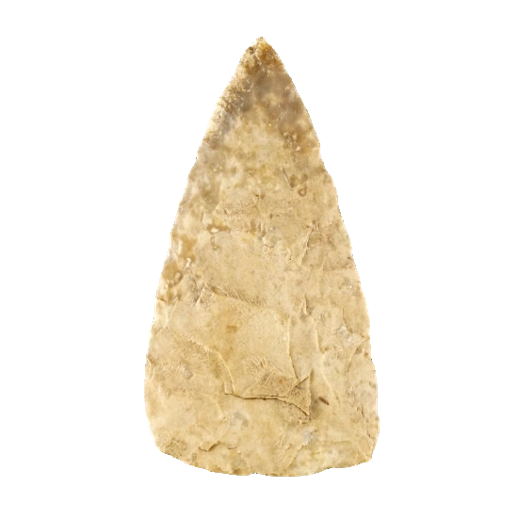
Arrowhead type
Covington Bi-Face Point
Covington Bi-Face4,000 - 3,000 B.P.Middle Archaic20 reference photos
Key facts
- Age
- 4,000 - 3,000 B.P.
- Cultural period
- Middle Archaic
- Size
- Medium to Large
- Shape
- Ovoid to Triangle
- Glacial period
- Neoglacial
More from the Archaic period
Description
The blade in question exhibits a robust morphology, characterized by a medium to large size and a cross-sectional profile that transitions from flattened to elliptical. Its excurvate shape is notable, often displaying a curvature that tapers inward at the distal end, sometimes accompanied by parallel lateral edges, while in other instances, the curvature reverses direction, sweeping back toward the proximal end. The basal margin varies in form, ranging from a straight line to a gently convex curve, with the basal corners consistently rounded. The flaking pattern observed on this blade is irregular and non-directional, lacking a discernible order or orientation, which is classified as a random flaking pattern.
Size
The dimensions of the arrowheads are characterized by a total length ranging from 70 to 140 mm and a blade width spanning 35 to 80 mm.
Distribution
This type is mainly located in the middle to lower regions of Texas.
Mainly found in
Additional information
In the realm of Native American arrowheads, the Covington Knife, Abasolo, and Refugio types exhibit distinct characteristics that set them apart from one another. Notably, the Covington Knife is distinguished by its broader shape, accompanied by more angular basal corners. In contrast, the Abasolo arrowhead is typically narrower, with basal corners that are rounded rather than angular. The Refugio type, while sharing similarities with the Abasolo, is generally larger in size. These variations in morphology highlight the diversity of arrowhead designs crafted by Native American communities in central Texas, where these types have been found.
The differences in basal corner shape and overall size among these arrowhead types may reflect the preferences and needs of the cultures that created them. The broader, more angular Covington Knife, for example, may have been designed for specific hunting or ceremonial purposes. Meanwhile, the narrower, rounded Abasolo may have been better suited for other tasks or activities. The larger Refugio type, with its similarities to the Abasolo, may represent a variation on a theme, with its increased size potentially indicating a different intended use or cultural significance.
The study of these arrowhead types, including the Covington Knife, Abasolo, and Refugio, offers valuable insights into the lives and traditions of Native American communities in central Texas. By examining the characteristics and variations among these artifacts, archaeologists can gain a deeper understanding of the cultural, technological, and environmental factors that shaped the lives of these communities. Furthermore, the comparison of these arrowhead types can inform our understanding of the broader cultural and historical context in which they were created, highlighting the complexity and diversity of Native American cultures in the region.
Identified by
- Named by
- Edward B. Jelks
- Year
- 1962
- Type site
- The Kyle Site, Hill County, Texas
Similar types
Types that are easy to confuse with the Covington Bi-Face point.
- Abasolo
- Darl Blade
- Friday
- Gahagan
- Kinney
- Mineral Springs
- Refugio
- Sabine
- San Gabriel