
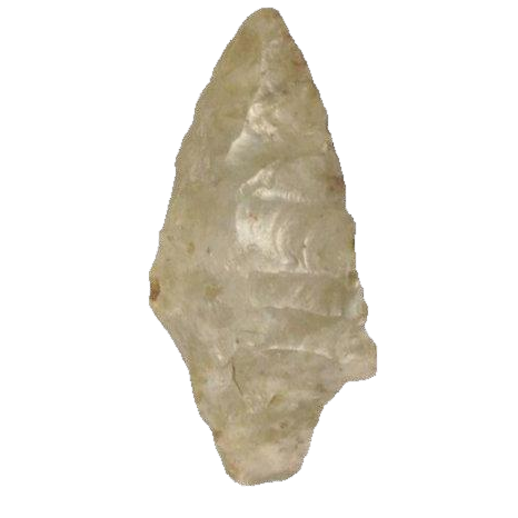
Arrowhead type
Conodoquinet - Canfield Point
Conodoquinet - Canfield4,000 - 3,500 B.P.Late Archaic2 reference photos
Key facts
- Age
- 4,000 - 3,500 B.P.
- Cultural period
- Late Archaic
- Size
- Medium
- Shape
- Contracting Stem
- Material
- Siltstone
- Glacial period
- Neoglacial
More from the Archaic period
Description
This medium-sized, triangular point features a contracting stem and an elliptical profile. Its blade exhibits an excurvate shape, curving outward in a smooth, continuous arc. The shoulders of the point display a range of orientations, from horizontal to slightly angled upwards, and are characterized by rounded edges. The stem tapers inward, terminating in a base with a subtle convex curvature. The flaking pattern observed on this point is random, lacking a discernible, organized arrangement.
Size
The dimensions of the arrowheads are as follows: they range in overall length from 35 to 60 mm, with stem lengths varying between 11 and 19 mm. The width of the blade spans from 21 to 38 mm, while the stem width measures between 14 and 20 mm.
Distribution
This type is documented throughout middle Pennsylvania and extending into Maryland.
Mainly found in
Additional information
In the realm of Native American archaeology, the Canfield point holds significant importance, named in honor of its discovery at the Canfield Island site, situated in Lycoming County, Pennsylvania. This notable archaeological find was first identified and documented by researchers Kent, Bressler, and Rockey. Upon further examination, it was revealed that the Canfield point shared identical characteristics with the Conodoquinet point, leading to the consolidation of these two designations under a single type. This taxonomic refinement has facilitated a more accurate understanding of the cultural and historical context in which these artifacts were crafted and utilized.
The convergence of the Canfield and Conodoquinet points underscores the complexities of archaeological nomenclature, where multiple names may be assigned to the same artifact type due to regional or contextual variations. By recognizing and reconciling these duplications, researchers can refine their understanding of the technological, social, and cultural developments of Native American communities. The Canfield point, now recognized as a distinct yet formerly duplicated entity, offers valuable insights into the lives and traditions of the indigenous peoples who created and employed these tools.
Through the study of the Canfield point and its equivalents, archaeologists can reconstruct aspects of the material culture, trade networks, and technological innovations of Native American societies, ultimately enriching our comprehension of the rich and diverse heritage of these communities. As archaeological research continues to evolve, the clarification of artifact types like the Canfield point serves as a testament to the ongoing refinement of our knowledge and the importance of precise classification in deciphering the historical record.
Identified by
- Named by
- Barry C. Kent
- Year
- 1970
- Type site
- The Canfield Island Site, Lycoming County, PA
Similar types
Types that are easy to confuse with the Conodoquinet - Canfield point.
- Dewart
- Duncan's Island
- Lehigh
- Lamoka
- Morrow Mountain
- Neville
- Piscataway
- Sand Hill