
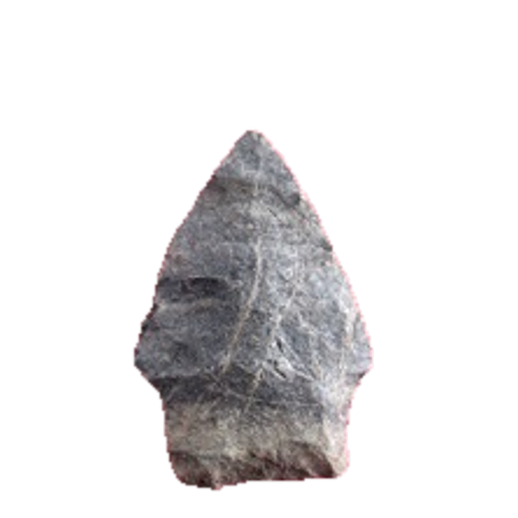
Arrowhead type
Calvert Point
Calvert3,100 - 2,500 B.P.Early Woodland4 reference photos
Key facts
- Age
- 3,100 - 2,500 B.P.
- Cultural period
- Early Woodland
- Size
- Small to Medium
- Shape
- Straight Stem to Contracting Stem to Expanding Stem
- Material
- Jasper
- Glacial period
- Neoglacial
More from the Woodland period
Description
This projectile point exhibits a distinctive triangular morphology, characterized by a small to medium-sized stem that broadens towards the base, forming an elliptical cross-sectional profile. The blade itself can display a range of curvature, from excurvate to straight, and is typically marked by a wide profile. Notably, the shoulders of the point are angled upward, creating a pronounced slope. The stem, which comprises 30 to 50 percent of the overall point length, can be either straight or slightly tapering. The basal edge is predominantly straight, although it may occasionally exhibit a subtle convexity. In terms of flaking pattern, this point features a random arrangement of flakes, lacking a discernible pattern or orientation.
Size
The arrowheads exhibit the following dimensional characteristics: overall length ranges from 25 to 48 mm, with a mean length of 36 mm. The width of the blade varies between 18 and 31 mm, averaging 22 mm. In terms of thickness, the measurements fall within the range of 8 to 13 mm.
Distribution
This type is mainly discovered in Maryland and extends into eastern Virginia and Delaware. Sightings have been documented in northeastern North Carolina and as far as Pennsylvania
Additional information
More information needed.
Identified by
- Named by
- Robert Stephenson and L. Ferguson
- Year
- 1963
- Type site
- Accokeek Creek Site, Calvert County, Maryland
Similar types
Types that are easy to confuse with the Calvert point.
- Dewart Stemmed
- Gypsy
- Lagoon
- Vernon