
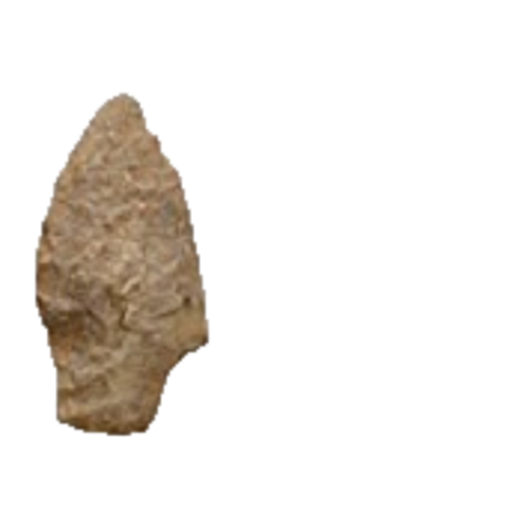
Arrowhead type
Gypsy Point
Gypsy2,500 - 1,500 B.P.WoodlandKey facts
- Age
- 2,500 - 1,500 B.P.
- Cultural period
- Woodland
- Size
- Small to Medium
- Shape
- Straight Stem to Contracting Stem
- Glacial period
- Roman Warm
More from the Woodland period
Description
This triangular point, measuring between 1 to 1.8 inches in length, exhibits an expanding stem and an elliptical profile. Its blade edge is characterized by an excurvate curvature. The shoulders are distinctly delineated, often oriented at an upward angle, although some specimens may display a horizontal alignment. The stem itself is predominantly straight, terminating in a base that is either straight or subtly convex. The flaking pattern observed on this point is random, lacking a discernible order or sequence.
Size
The dimensions of the arrowheads range from 28 to 50 mm in length, with a width spanning 17 to 29 mm, and a thickness varying between 6 and 10 mm.
Distribution
This type is mainly discovered in the Piedmont and extending into the Blue Mountain areas of North Carolina and onward into Virginia
Mainly found in
Additional information
The evolution of Native American arrowheads in the southeastern United States is a fascinating topic, with various regional traditions influencing one another. In the Piedmont region, a specific type of arrowhead emerged, characterized by a stemmed design. This style is believed to have been a precursor to subsequent types, including the Savannah River and Savannah River Small, which eventually gave rise to the Gypsy type. Notably, this transitional period, as discussed by Oliver (1999), may have marked a significant shift in local cultures, as they adapted the traditional stemmed forms of the Archaic period to accommodate the introduction of bow and arrow technology.
A key aspect of this arrowhead type is its similarity to the older Otarre type, making differentiation between the two a challenging task. Despite these similarities, archaeologists recognize the distinctive characteristics of each type, allowing for a more nuanced understanding of the cultural and technological developments in the region. The study of these arrowhead types provides valuable insights into the lives and traditions of Native American communities, highlighting the complex and dynamic nature of their cultural evolution.
The significance of this arrowhead type lies in its representation of a pivotal moment in the history of Native American technology and culture. As local populations transitioned from traditional forms to new technologies, their arrowhead designs reflect this process of adaptation and innovation. By examining these artifacts, researchers can gain a deeper understanding of the regional cultural landscape and the ways in which different communities responded to changing circumstances, ultimately shedding light on the rich and diverse heritage of Native American cultures in the southeastern United States.
Identified by
- Named by
- Bill Oliver
- Year
- 1981
- Type site
- Multiple site (Doerschuk, Gaston, Thelma, Warren Wilson), North Carolina
Similar types
Types that are easy to confuse with the Gypsy point.
- Otarre