
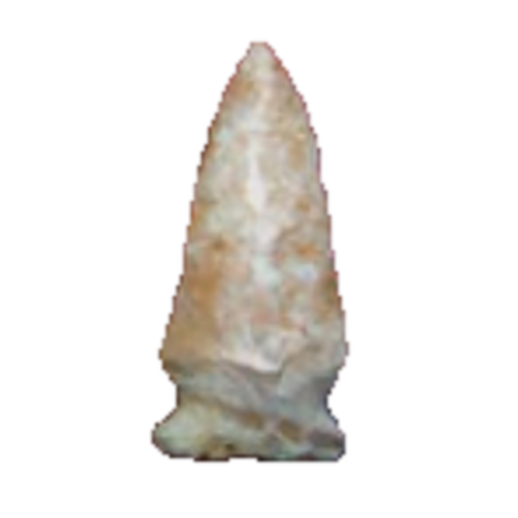
Arrowhead type
Cairo Point
CairoMatanzas Cluster4,000 - 3,000 B.P.Late ArchaicKey facts
- Age
- 4,000 - 3,000 B.P.
- Cultural period
- Late Archaic
- Size
- Medium
- Shape
- Side Notch
- Glacial period
- Neoglacial
More from the Archaic period
Description
This side notch point measures between 2 to 3.5 inches in length and exhibits an elliptical cross-sectional profile, characterized by a pronounced median ridge. The blade itself is slender, displaying a curvature that varies from excurvate to straight along its length. Notable are the shallow, broad notches that are situated near the base, creating a shoulder with a subtle upward inclination and a short, expanding stem. The basal edge remains straight. The point's manufacture involves percussion flaking applied alternately from each side, resulting in the formation of a median ridge on both faces, with final refinement achieved through fine pressure flaking applied along both edges.
Size
Medium
Distribution
This type is mainly discovered throughout the southern Illinois region near Cairo.
Additional information
In the realm of Native American archaeology, the Cairo (Side Notch) arrowhead is a notable example of projectile point technology, first described by Howard D. Winters based on discoveries at the Briscoe Mound site (11WI25) near Cairo, Illinois. Characterized by their medium size, typically ranging from 2 to 3.5 inches in length, these narrow and thin projectiles and knives feature sharp to rounded tips, with parallel blade edges that underscore their functional design. A distinctive trait of the Cairo (Side Notch) is the presence of round shoulders, accompanied by wide, shallow side indentations positioned close to the base, which is short, expanded, and marked by straight basal edges.
The manufacturing process of these arrowheads involved primary percussion flaking from each side towards the center, resulting in the formation of median ridges. This was followed by a secondary treatment of light pressure flaking along the blade edges, indicative of a refined finishing technique. Cross-sectional analysis reveals a biconvex profile, a characteristic that adds to the arrowhead's aerodynamic efficiency. The distribution of the Cairo (Side Notch) arrowheads is predominantly found within the upper Mississippi River Valley, a region that was inhabited by various Native American groups during the Late Archaic period. This temporal context highlights the significance of these artifacts in understanding the technological and cultural developments of the time.
The work of Howard D. Winters, as documented in his 1967 publication "An Archaeological Survey of the Wabash Valley" and his earlier 1959 report "Projectile Points of the Cache River Valley," provides invaluable insights into the characteristics and distribution of the Cairo (Side Notch) arrowheads. These studies, conducted under the auspices of the Illinois State Museum, have contributed substantially to our knowledge of Native American archaeology, particularly in relation to the projectile point technologies of the region. By examining the design, manufacture, and distribution of these arrowheads, researchers can gain a deeper understanding of the cultural and technological practices of the Native American communities that once flourished in the upper Mississippi River Valley.
Identified by
- Named by
- Howard D. Winters
- Year
- 1959
- Type site
- Brisco Mound site (11WI23), near Cairo, Illinois
Similar types
Types that are easy to confuse with the Cairo point.