
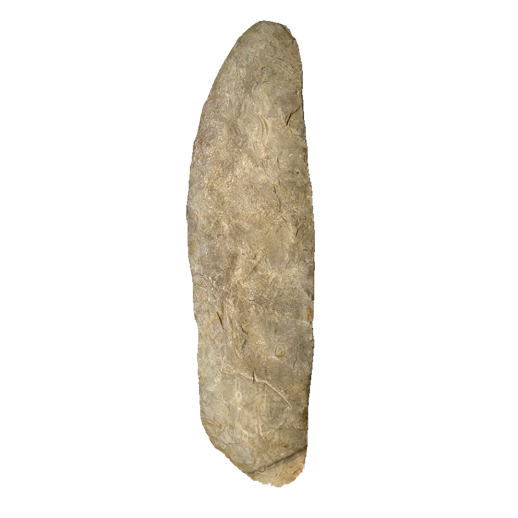
Arrowhead type
Caddo Blade
Caddo Blade800 - 600 B.P.Mississippian13 reference photos
Key facts
- Age
- 800 - 600 B.P.
- Cultural period
- Mississippian
- Culture
- Caddo Culture
- Size
- Large
- Shape
- Ovoid
- Glacial period
- Medieval
More from the Mississippian period
Description
This ovoid blade exhibits a slender profile, characterized by a large to very large size and a cross-sectional morphology that is notably flattened. Its excurvate shape is defined by an inward curvature at the distal end, which then reverses direction, sweeping back towards the proximal base. The blade's edge is distinguished by the presence of serrations, often encircling the tip, while the base displays variability in shape, ranging from a pointed to a convex configuration. The overall craftsmanship of this blade is of high quality, with a flaking pattern that appears random and lacking in discernible order.
Size
The dimensions of the arrowheads are characterized by a total length ranging from 150 to 240 mm and a blade width spanning 40 to 60 mm.
Distribution
This style is linked to the Caddo tradition and occurs at locations tied to the Caddo in Arkansas and extending into Oklahoma, Texas, and Louisiana
Additional information
The Caldwell Collection is notable for its extensive array of Native American arrowheads, with several examples attributed to this particular type. Notably, these artifacts were allegedly unearthed from a cache at the Spiro Mounds, a significant archaeological site. However, a review of professional publications reveals that no additional examples of this type have been documented as being recovered from the Spiro Mounds, as observed by Wagers in 2011. This discrepancy highlights the importance of verifying provenance and documentation in archaeological research, ensuring the accuracy and reliability of our understanding of these cultural artifacts.
The Spiro Mounds, a site of great historical and cultural significance, have yielded a wealth of information about the lives and traditions of Native American communities. The recovery of artifacts from this site, including those in the Caldwell Collection, provides valuable insights into the technological, social, and ceremonial practices of these communities. The fact that no other examples of this arrowhead type have been reported from the Spiro Mounds in professional publications suggests that the Caldwell Collection may hold a unique position in the archaeological record, warranting further study and analysis.
Further research into the Caldwell Collection and its connection to the Spiro Mounds could shed new light on the cultural and historical context of these arrowheads, as well as the significance of the cache from which they were recovered. By examining the characteristics, materials, and craftsmanship of these artifacts, archaeologists can gain a deeper understanding of the technological and artistic traditions of Native American communities, ultimately enriching our appreciation of their cultural heritage. As observed by Wagers in 2011, the lack of additional reported examples from the Spiro Mounds underscores the importance of continued investigation and documentation, ensuring that our knowledge of these artifacts and their contexts remains accurate and comprehensive.
Similar types
Types that are easy to confuse with the Caddo Blade point.
- Dagger Knife
- Duck River Blade
- Morse Knife
- Snake Creek Blade
- Ramey Knife
- Ross Blade